
Reykjavik - Kulusuk - Nuuk
Flight / Schedule
Reykjavik - Kulusuk - Nuuk
Aircraft
De Havilland DHC-8-100 (Dash-8)Registration
TF-JMB
MSN
337
Year of Manufacture
1992
Operator
Flugfélag ÍslandsDate
March 4, 2011 at 04:09 PM
Type
CRASHFlight Type
Scheduled Revenue Flight
Flight Phase
Landing (descent or approach)
Crash Site
Airport (less than 10 km from airport)
Crash Location
Nuuk (Godthåb) Kommuneqarfik Sermersooq
Region
Europe • Greenland
Coordinates
64.1910°, -51.6965°
Crash Cause
Human factor
Narrative Report
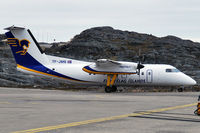
On March 4, 2011 at 04:09 PM, Reykjavik - Kulusuk - Nuuk experienced a crash involving De Havilland DHC-8-100 (Dash-8), operated by Flugfélag Íslands, with the event recorded near Nuuk (Godthåb) Kommuneqarfik Sermersooq.
The flight was categorized as scheduled revenue flight and the reported phase was landing (descent or approach) at a airport (less than 10 km from airport) crash site.
34 people were known to be on board, 0 fatalities were recorded, 34 survivors were identified or estimated. This corresponds to an estimated fatality rate of 0.0%.
Crew on board: 3, crew fatalities: 0, passengers on board: 31, passenger fatalities: 0, other fatalities: 0.
The listed crash cause is human factor. The flight crew got visual contact with the runway at BGGH and decided to deviate to the right (west) of the offset localizer (LLZ) to runway 23. The flight continued towards the runway from a position right of the extended runway centerline. As the aircraft approached runway 23, it was still in the final right turn over the landing threshold. The aircraft touched down on runway 23 between the runway threshold and the touchdown zone and to the left of the runway centerline. The right main landing gear (MLG) shock strut fuse pin sheared leading to a right MLG collapse. The aircraft skidded down the runway and departed the runway to the right. Neither passengers nor crew suffered any injuries. The aircraft was substantially damaged. The accident occurred in daylight under visual meteorological conditions (VMC).
Aircraft reference details include registration TF-JMB, MSN 337, year of manufacture 1992.
Geospatial coordinates for this crash are approximately 64.1910°, -51.6965°.
Fatalities
Total
0
Crew
0
Passengers
0
Other
0
Crash Summary
The flight crew got visual contact with the runway at BGGH and decided to deviate to the right (west) of the offset localizer (LLZ) to runway 23. The flight continued towards the runway from a position right of the extended runway centerline. As the aircraft approached runway 23, it was still in the final right turn over the landing threshold. The aircraft touched down on runway 23 between the runway threshold and the touchdown zone and to the left of the runway centerline. The right main landing gear (MLG) shock strut fuse pin sheared leading to a right MLG collapse. The aircraft skidded down the runway and departed the runway to the right. Neither passengers nor crew suffered any injuries. The aircraft was substantially damaged. The accident occurred in daylight under visual meteorological conditions (VMC).
Cause: Human factor
Occupants & Outcome
Crew On Board
3
Passengers On Board
31
Estimated Survivors
34
Fatality Rate
0.0%
Known people on board: 34
Operational Details
Schedule / Flight
Reykjavik - Kulusuk - Nuuk
Operator
Flugfélag ÍslandsFlight Type
Scheduled Revenue Flight
Flight Phase
Landing (descent or approach)
Crash Site
Airport (less than 10 km from airport)
Region / Country
Europe • Greenland
Aircraft Details
Similar Plane Crashes
George R. Hutchinson
Sikorsky S-38
Owned by the American Lt Colonel George R. Hutchinson, the seaplane was on its way from New York to London on a private and nonstop transatlantic flight with seven passengers and a crew of two on board. En route, the crew encountered snow falls and the aircraft was too heavy due to snow accumulation. The pilot attempted an emergency landing off the Greenland coast but after landing, the airplane struck an iceberg and was seriously damaged. Several distress calls were sent but the aircraft moved on rough seas. The aircraft was eventually localized by the crew of the British fishing trawler named 'Lord Talbot' on September 18, five days after the accident, some 40 miles southwest of Angmagssalik (Tasiilaq). All nine occupants were rescued and repatriated to Europe. Lt Colonel Hutchinson was travelling with his wife Blanche and his two girls, Kathryn (8) and Janet Lee (6). The aircraft was lost and abandoned as a wing was torn off. Crew: Lt Colonel George R. Hutchinson +1. Passengers: Blanche Hutchinson, Kathryn Hutchinson, Janet Lee Hutchinson, Peter Redpath, Joseph Ruff, Gerald Altfilisch, Norman Alley, American filmmaker.
United States Army Air Forces - USAAF
Boeing B-17 Flying Fortress
Crashed in unknown circumstances somewhere in Greenland while being transferred from the US to Europe. There were no casualties but the aircraft christened 'Alabama Exterminator' was damaged beyond repair.
United States Army Air Forces - USAAF
Douglas C-53 Skytrooper (DC-3)
The aircraft crashed in unknown circumstances on the east coast of Greenland. SAR operations were conducted but eventually suspended few days later as no trace of the aircraft was found. The aircraft was finally spotted five months later and on site, rescuers found the five crew members alive. They lived five months in the tail of the aircraft by outside temperature down to -40° C. Source: ASN & 'Frozen in Time' by Mitchell Zuckoff.
United States Navy - USN
Consolidated PBY-5A Catalina
This accident occurred while flying over Greenland Ice Cap at an altitude of 4500-ft indicated. This should have given a clearance of 1000-ft according to charts of the area. Weather and snow covered terrain resulted in poor depth perception. Without realizing they were close to the ice, as a horizon was visible and were not on instruments, they suddenly made contact on the upgrade of a 400-ft slope. the pilot immediately applied throttles in an attempt to get into air but was unsuccessful due to the slope. Further attempts to swing plane around in order to take-off down grade were unsuccessful as plane sank into snow and ice. Block and tackle was dropped, but that also proved unsuccessful. The Ice Cap presents an unbroken pure white surface and when the prominent cost of landmarks are not visible, depth perception is extremely difficult, analagons to flying over glassy water in low visibility. It is considered that the fundamental cause of this accident was the almost lack of depth perception. This plane and its crew were strained on the ice cap for fifteen days, but were in constant touch with there base by radio. A plane dropped supplies and salvage equipment. On the 14th day a Danish Rescue party reached them. On the fifteenth day they abandoned there plane, all confidential publications, the IFF, SBAE and RADAR being destroyed. They returned by foot to the rescue party's came and on the sixteenth day returned to the NORTH STAR. Except for extreme cold, none of the crew suffered any ill effects. Crew: Lt R. W. Shepard, pilot, Lt A. H. Gilster, copilot, AP2c M. V. Egert, Amm2c N. J. Richey Jr., Amm3c W. Blankenship, Rm1c J. J. Rutowski, Rm3c E. R. Herbert. Source: http://www.warcovers.dk/greenland/crash270143.htm
United States Army Air Forces - USAAF
Boeing B-29 Superfortress
The crew left Fort Wainwright (Ladd Field) on a Top Secret flight over Soviet Union, a mission that should take from 12 to 20 hours. While returning to his base and flying over Greenland at an altitude of 24,000 feet, the crew encountered poor weather conditions and lost his orientation. The pilot was unable to locate his position and informed his base that he was forced to attempt an emergency landing as the fuel reserve was four minutes only. The aircraft crash landed on an icy area located about 280 NM north of Thule Airbase. The crew was rescued three days later and the aircraft christened 'Kee Bird' was abandoned. A team was created in the nineties to recover the wreckage but unfortunately, on May 21, 1995, the aircraft caught fire following a fuel leak and was destroyed. Crew (46th Reconnaissance Squadron): Vern Arnett, pilot, Russel S. Jordan, copilot, Talbert Gates, copilot, John G. Lesman, astro navigator, Burl Cowan, navigator, Robert Luedke, flight engineer, Howard Adams, radar observer, Lawrence Yarborough, gunner,0 Ernie Stewart, gunner, Paul McNamara, gunner, Robert Leader, radio operator.
Flugfélag Íslands
Douglas DC-3
Enroute from Reykjavik to Akureyri, while flying in marginal weather conditions east of the city of Siglufjörður, the aircraft hit the slope of Mt Hestfjall located on the west coast of the Héðinsfjörður Bay. The aircraft was totally destroyed and all 25 occupants were killed. Up to date, worst airplane crash in Iceland History.