
Windsor Locks - Halifax - Zaragoza
Flight / Schedule
Windsor Locks - Halifax - Zaragoza
Aircraft
Boeing 747-200Registration
9G-MKJ
MSN
22170
Year of Manufacture
1980
Operator
MK AirlinesDate
October 14, 2004 at 03:56 AM
Type
CRASHFlight Type
Cargo
Flight Phase
Takeoff (climb)
Crash Site
Airport (less than 10 km from airport)
Crash Location
Halifax-Stanfield Nova Scotia
Region
North America • Canada
Coordinates
44.8809°, -63.5011°
Crash Cause
Human factor
Narrative Report
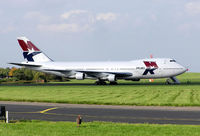
On October 14, 2004 at 03:56 AM, Windsor Locks - Halifax - Zaragoza experienced a crash involving Boeing 747-200, operated by MK Airlines, with the event recorded near Halifax-Stanfield Nova Scotia.
The flight was categorized as cargo and the reported phase was takeoff (climb) at a airport (less than 10 km from airport) crash site.
7 people were known to be on board, 7 fatalities were recorded, 0 survivors were identified or estimated. This corresponds to an estimated fatality rate of 100.0%.
Crew on board: 7, crew fatalities: 7, passengers on board: 0, passenger fatalities: 0, other fatalities: 0.
The listed crash cause is human factor. MKA1602 landed on Runway 24 at Halifax International Airport at 0512 and taxied to the ramp. After shutdown, loading of the aircraft was started. During the loading, two MK Airlines Limited crew members were observed sleeping in the upper deck passenger seats. After the fuelling was complete, the ground engineer checked the aircraft fuelling panel and signed the fuel ticket. The aircraft had been uploaded with 72 062 kg of fuel, for a total fuel load of 89 400 kg. The ground engineer then went to the main cargo deck to assist with the loading. Once the loading was complete, the ramp supervisor for the ground handling agent went to the upper deck to retrieve the MKA1602 cargo and flight documentation. While the loadmaster was completing the documentation, the ramp supervisor visited the cockpit and noted that the first officer was not in his seat. Approximately 10 minutes later, the ramp supervisor, with the documentation, left the aircraft. At 0647, the crew began taxiing the aircraft to position on Runway 24, and at 0653, the aircraft began its take-off roll. See Section 1.11.4 of this report for a detailed sequence of events for the take-off. During rotation, the aircraftís lower aft fuselage briefly contacted the runway. A few seconds later, the aircraftís lower aft fuselage contacted the runway again but with more force. The aircraft remained in contact with the runway and the ground to a point 825 feet beyond the end of the runway, where it became airborne and flew a distance of 325 feet. The lower aft fuselage then struck an earthen berm supporting an instrument landing system (ILS) localizer antenna. The aircraft's tail separated on impact, and the rest of the aircraft continued in the air for another 1200 feet before it struck terrain and burst into flames. The final impact was at latitude 44°52'51" N and longitude 063°30'31" W, approximately 2500 feet past the departure end of Runway 24, at an elevation of 403 feet above sea level (asl). The aircraft was destroyed by impact forces and post-crash fire. All persons on board (seven crew members) were fatally injured.
Aircraft reference details include registration 9G-MKJ, MSN 22170, year of manufacture 1980.
Geospatial coordinates for this crash are approximately 44.8809°, -63.5011°.
Fatalities
Total
7
Crew
7
Passengers
0
Other
0
Crash Summary
MKA1602 landed on Runway 24 at Halifax International Airport at 0512 and taxied to the ramp. After shutdown, loading of the aircraft was started. During the loading, two MK Airlines Limited crew members were observed sleeping in the upper deck passenger seats. After the fuelling was complete, the ground engineer checked the aircraft fuelling panel and signed the fuel ticket. The aircraft had been uploaded with 72 062 kg of fuel, for a total fuel load of 89 400 kg. The ground engineer then went to the main cargo deck to assist with the loading. Once the loading was complete, the ramp supervisor for the ground handling agent went to the upper deck to retrieve the MKA1602 cargo and flight documentation. While the loadmaster was completing the documentation, the ramp supervisor visited the cockpit and noted that the first officer was not in his seat. Approximately 10 minutes later, the ramp supervisor, with the documentation, left the aircraft. At 0647, the crew began taxiing the aircraft to position on Runway 24, and at 0653, the aircraft began its take-off roll. See Section 1.11.4 of this report for a detailed sequence of events for the take-off. During rotation, the aircraftís lower aft fuselage briefly contacted the runway. A few seconds later, the aircraftís lower aft fuselage contacted the runway again but with more force. The aircraft remained in contact with the runway and the ground to a point 825 feet beyond the end of the runway, where it became airborne and flew a distance of 325 feet. The lower aft fuselage then struck an earthen berm supporting an instrument landing system (ILS) localizer antenna. The aircraft's tail separated on impact, and the rest of the aircraft continued in the air for another 1200 feet before it struck terrain and burst into flames. The final impact was at latitude 44°52'51" N and longitude 063°30'31" W, approximately 2500 feet past the departure end of Runway 24, at an elevation of 403 feet above sea level (asl). The aircraft was destroyed by impact forces and post-crash fire. All persons on board (seven crew members) were fatally injured.
Cause: Human factor
Occupants & Outcome
Crew On Board
7
Passengers On Board
0
Estimated Survivors
0
Fatality Rate
100.0%
Known people on board: 7
Operational Details
Schedule / Flight
Windsor Locks - Halifax - Zaragoza
Operator
MK AirlinesFlight Type
Cargo
Flight Phase
Takeoff (climb)
Crash Site
Airport (less than 10 km from airport)
Region / Country
North America • Canada
Aircraft Details
Similar Plane Crashes
Royal Canadian Air Force - RCAF
Avro 504
The pilot, sole on board, was completing a local training flight at Camp Borden Airport. The airplane crashed on takeoff. The pilot was rescued.
Royal Canadian Air Force - RCAF
De Havilland DH.9
Crashed in unknown circumstances.
Canadian Aircraft Company
Avro 504
On approach to Fort Frances, the aircraft stalled and crashed. Both occupants were injured.
Bishop-Barker Aeroplanes
Curtiss HS-2L
Hit tree tops and crashed in Brooklin, north of Oshawa, Ontario. Crew fate unknown.
Vancouver Island Aerial Service
Curtiss JN-4
En route from Alert Bay to Prince Rupert, the pilot Lt Harry W. Brown encountered an unexpected situation and was forced to ditch the aircraft off Nalau Island. He survived by paddling a log into the shipping lane and was picked up by a passing Alaskan steamer. The aircraft was lost.
Royal Canadian Air Force - RCAF
De Havilland DH.9
Crashed in unknown circumstances. Crew fate unknown.