
Bartow – Key West
Flight / Schedule
Bartow – Key West
Aircraft
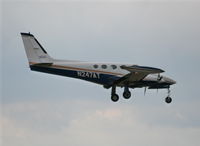
Cessna 340Registration
N247AT
MSN
340-0214
Year of Manufacture
1973
Operator
Aviation TransportationDate
December 24, 2017 at 07:17 AM
Type
CRASHFlight Type
Private
Flight Phase
Takeoff (climb)
Crash Site
Airport (less than 10 km from airport)
Crash Location
Bartow Florida
Region
North America • United States of America
Coordinates
27.8964°, -81.8433°
Crash Cause
Human factor
Narrative Report
On December 24, 2017 at 07:17 AM, Bartow – Key West experienced a crash involving Cessna 340, operated by Aviation Transportation, with the event recorded near Bartow Florida.
The flight was categorized as private and the reported phase was takeoff (climb) at a airport (less than 10 km from airport) crash site.
5 people were known to be on board, 5 fatalities were recorded, 0 survivors were identified or estimated. This corresponds to an estimated fatality rate of 100.0%.
Crew on board: 1, crew fatalities: 1, passengers on board: 4, passenger fatalities: 4, other fatalities: 0.
The listed crash cause is human factor. The instrument-rated private pilot and four passengers boarded the multiengine airplane inside a hangar. The pilot then requested that the airplane be towed from the hangar to the ramp, since he did not want to hit anything on the ramp while taxiing in the dense fog. Witnesses heard the pre-takeoff engine run-up toward the end of the runway but could not see the airplane as it departed; the engines sounded normal during the run-up and takeoff. A witness video recorded the takeoff but the airplane was not visible due to the dense fog. During the takeoff roll the airplane's tires chirped, which is consistent with the wheels touching down on the runway with a side load. The video ended before the accident occurred. The witnesses stated that the takeoff continued and then they heard the airplane impact the ground and saw an explosion. The weather conditions at the time of the accident included visibility less than 1/4 mile in fog and an overcast ceiling at 300 ft above ground level. The airplane's weight at the time of the accident was about 105 lbs over the maximum takeoff weight, which exceeded the center of gravity moment envelope. The excess weight would have likely extended the takeoff roll, decreased the climb rate, and increased the amount of elevator pressure required to lift off of the runway. A majority of the airplane was consumed by postcrash fire. The ground impact marks and wreckage distribution were consistent with the airplane rolling left over the departure end of the runway and impacting the ground inverted in a nearly vertical, nose-low attitude. Examination of the engines revealed operating signatures consistent with takeoff power at the time of impact. The elevator trim tab and actuator were found beyond their full up travel limits and the trim cable exhibited tension overload separations near the actuator. It is likely that, when the cable separated in overload, the chain turned the sprocket and extended the actuator rod beyond full travel. No anomalies were observed with the airframe, engines, or cockpit instrumentation that would have precluded normal operation. The investigation was unable to determine the status of the autopilot during the accident takeoff. Based on the evidence it's likely that when the airplane entered instrument meteorological conditions the pilot experienced spatial disorientation, which resulted in a loss of control and descent into terrain.
Aircraft reference details include registration N247AT, MSN 340-0214, year of manufacture 1973.
Geospatial coordinates for this crash are approximately 27.8964°, -81.8433°.
Fatalities
Total
5
Crew
1
Passengers
4
Other
0
Crash Summary
The instrument-rated private pilot and four passengers boarded the multiengine airplane inside a hangar. The pilot then requested that the airplane be towed from the hangar to the ramp, since he did not want to hit anything on the ramp while taxiing in the dense fog. Witnesses heard the pre-takeoff engine run-up toward the end of the runway but could not see the airplane as it departed; the engines sounded normal during the run-up and takeoff. A witness video recorded the takeoff but the airplane was not visible due to the dense fog. During the takeoff roll the airplane's tires chirped, which is consistent with the wheels touching down on the runway with a side load. The video ended before the accident occurred. The witnesses stated that the takeoff continued and then they heard the airplane impact the ground and saw an explosion. The weather conditions at the time of the accident included visibility less than 1/4 mile in fog and an overcast ceiling at 300 ft above ground level. The airplane's weight at the time of the accident was about 105 lbs over the maximum takeoff weight, which exceeded the center of gravity moment envelope. The excess weight would have likely extended the takeoff roll, decreased the climb rate, and increased the amount of elevator pressure required to lift off of the runway. A majority of the airplane was consumed by postcrash fire. The ground impact marks and wreckage distribution were consistent with the airplane rolling left over the departure end of the runway and impacting the ground inverted in a nearly vertical, nose-low attitude. Examination of the engines revealed operating signatures consistent with takeoff power at the time of impact. The elevator trim tab and actuator were found beyond their full up travel limits and the trim cable exhibited tension overload separations near the actuator. It is likely that, when the cable separated in overload, the chain turned the sprocket and extended the actuator rod beyond full travel. No anomalies were observed with the airframe, engines, or cockpit instrumentation that would have precluded normal operation. The investigation was unable to determine the status of the autopilot during the accident takeoff. Based on the evidence it's likely that when the airplane entered instrument meteorological conditions the pilot experienced spatial disorientation, which resulted in a loss of control and descent into terrain.
Cause: Human factor
Occupants & Outcome
Crew On Board
1
Passengers On Board
4
Estimated Survivors
0
Fatality Rate
100.0%
Known people on board: 5
Operational Details
Schedule / Flight
Bartow – Key West
Operator
Aviation TransportationFlight Type
Private
Flight Phase
Takeoff (climb)
Crash Site
Airport (less than 10 km from airport)
Region / Country
North America • United States of America
Aircraft Details
Similar Plane Crashes
United States Signal Corps - USSC
De Havilland DH.4
The single engine airplane departed Dayton-McCook Field for a local test flight. Shortly after takeoff, the aircraft stalled and crashed, killing both occupants. Crew: Maj Oscar Brindley, Lt Col Henry Damm.
United States Signal Corps - USSC
De Havilland DH.4
Lt. Frank Stuart Patterson, son and nephew of the co-founders of National Cash Register, is killed in the crash of his DH.4M, AS-32098, at Wilbur Wright Field during a flight test of a new mechanism for synchronizing machine gun and propeller, when a tie rod breaks during a dive from 15,000 feet (4,600 m), causing the wings to separate from the aircraft. Wishing to recognize the contributions of the Patterson family (owners of NCR) the area of Wright Field east of Huffman Dam (including Wilbur Wright Field, Fairfield Air Depot, and the Huffman Prairie) is renamed Patterson Field on 6 July 1931, in honor of Lt. Patterson.
United States Signal Corps - USSC
De Havilland DH.4
The aircraft crashed in unknown circumstances.
United States Signal Corps - USSC
De Havilland DH.4
The crew was completing a training mission. At an altitude of about 4,000 feet, the aircraft entered a spin and crashed in an open field near Everman-Barron Field Airport. A crew was killed and the second occupants was injured. The aircraft was destroyed.
U.S. Air Mail Service
De Havilland DH.4
Crashed following an engine failure. Pilot fate unknown.
United States Signal Corps - USSC
De Havilland DH.4
The accident occurred in unknown circumstances.