
Memphis - Fort Lauderdale
Flight / Schedule
Memphis - Fort Lauderdale
Aircraft
Douglas DC-10Registration
N370FE
MSN
46608
Year of Manufacture
1972
Operator
Federal Express - FedExDate
October 28, 2016 at 05:51 PM
Type
CRASHFlight Type
Cargo
Flight Phase
Landing (descent or approach)
Crash Site
Airport (less than 10 km from airport)
Crash Location
Fort Lauderdale-Hollywood Florida
Region
North America • United States of America
Coordinates
26.0720°, -80.1510°
Crash Cause
Technical failure
Narrative Report
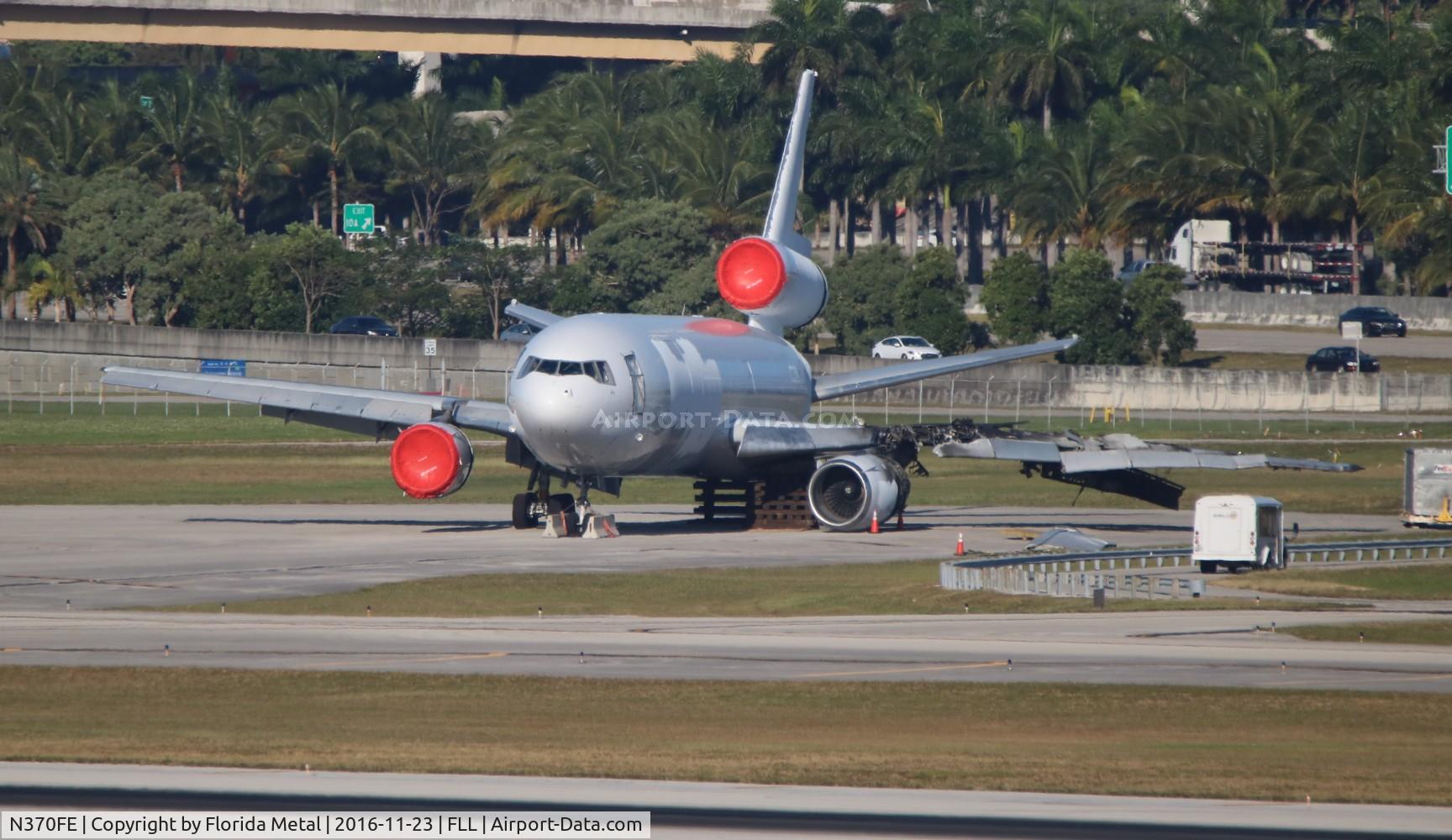
On October 28, 2016 at 05:51 PM, Memphis - Fort Lauderdale experienced a crash involving Douglas DC-10, operated by Federal Express - FedEx, with the event recorded near Fort Lauderdale-Hollywood Florida.
The flight was categorized as cargo and the reported phase was landing (descent or approach) at a airport (less than 10 km from airport) crash site.
2 people were known to be on board, 0 fatalities were recorded, 2 survivors were identified or estimated. This corresponds to an estimated fatality rate of 0.0%.
Crew on board: 2, crew fatalities: 0, passengers on board: 0, passenger fatalities: 0, other fatalities: 0.
The listed crash cause is technical failure. On October 28, 2016, about 1751 eastern daylight time, FedEx Express (FedEx) flight 910, a McDonnell Douglas MD-10-10F, N370FE, experienced a left main landing gear (MLG) collapse after landing on runway 10L at Fort Lauderdale–Hollywood International Airport (KFLL), Fort Lauderdale, Florida, and the left wing subsequently caught fire. The airplane came to rest off the left side of the runway. The two flight crew members evacuated the airplane. The captain reported a minor cut and abrasions from the evacuation, and the first officer was not injured. The airplane sustained substantial damage. The cargo flight was operating on an instrument flight plan under the provisions of Title 14 Code of Federal Regulation (CFR) Part 121 and originated at Memphis International Airport (KMEM), Memphis, Tennessee. The first officer was the pilot flying, and the captain was the pilot monitoring. Both flight crew members stated in post accident interviews that the departure from MEM and the en route portion of the flight were normal. About 1745, air traffic control (ATC) cleared the flight for final approach to the instrument landing system (ILS) approach to runway 10L at KFLL. Recorder data indicate that the first officer set the flaps at 35º about 1746 when the airplane was 3,000 ft above ground level (agl). The first officer disconnected the autopilot about 1749 when the airplane was 1,000 ft agl. Both flight crew members reported that the approach was stable at 500 ft agl. At 200 ft agl, the first officer began making airspeed corrections to compensate for the crosswind. About 1750, the first officer disconnected the autothrottles, as briefed, when the airplane was at 100 ft agl. At 50 ft agl, the first officer initiated the flare. The left MLG touched down about 1750:31 in the touchdown zone and left of the runway centerline. The first officer deployed the spoilers at 1750:34, and the nose gear touched down 3 seconds later. The thrust reversers were deployed at 1750:40. According to cockpit voice recorder (CVR) data, the captain instructed the first officer to begin braking about 1750:39 (the airplane was not equipped with autobrakes). FDR data indicate an increase in brake pedal position angle and increase in longitudinal deceleration (indicating braking) about 1750:41. In post accident interviews, the flight crew members reported hearing a "bang" as the first officer applied the brakes, and the airplane yawed to the left. About this time, the CVR recorded the sound of multiple thuds, consistent with the sound of a gear collapse. About 1750:48, the captain stated, "I have the airplane," and the first officer replied, "you got the airplane." The captain applied full right rudder without effect while the first officer continued braking. About 1750:53, the captain instructed the first officer to call and inform the tower about the emergency. An airport video of the landing showed that the No. 1 engine was initially supporting the airplane after the left MLG collapse when a fire began near the left-wing tip. The airplane eventually stopped off the left side of runway 10L, about 30º to 40º off the runway heading. About 1751, the flight crew began executing the evacuation checklist. The pilots reported that, as they were about to evacuate, they heard an explosion. The airport video showed a fireball erupted at the No. 1 engine. The captain attempted to discharge a fire bottle in the No. 1 engine, but it didn't discharge. They evacuated the airplane through the right cockpit window.
Aircraft reference details include registration N370FE, MSN 46608, year of manufacture 1972.
Geospatial coordinates for this crash are approximately 26.0720°, -80.1510°.
Fatalities
Total
0
Crew
0
Passengers
0
Other
0
Crash Summary
On October 28, 2016, about 1751 eastern daylight time, FedEx Express (FedEx) flight 910, a McDonnell Douglas MD-10-10F, N370FE, experienced a left main landing gear (MLG) collapse after landing on runway 10L at Fort Lauderdale–Hollywood International Airport (KFLL), Fort Lauderdale, Florida, and the left wing subsequently caught fire. The airplane came to rest off the left side of the runway. The two flight crew members evacuated the airplane. The captain reported a minor cut and abrasions from the evacuation, and the first officer was not injured. The airplane sustained substantial damage. The cargo flight was operating on an instrument flight plan under the provisions of Title 14 Code of Federal Regulation (CFR) Part 121 and originated at Memphis International Airport (KMEM), Memphis, Tennessee. The first officer was the pilot flying, and the captain was the pilot monitoring. Both flight crew members stated in post accident interviews that the departure from MEM and the en route portion of the flight were normal. About 1745, air traffic control (ATC) cleared the flight for final approach to the instrument landing system (ILS) approach to runway 10L at KFLL. Recorder data indicate that the first officer set the flaps at 35º about 1746 when the airplane was 3,000 ft above ground level (agl). The first officer disconnected the autopilot about 1749 when the airplane was 1,000 ft agl. Both flight crew members reported that the approach was stable at 500 ft agl. At 200 ft agl, the first officer began making airspeed corrections to compensate for the crosswind. About 1750, the first officer disconnected the autothrottles, as briefed, when the airplane was at 100 ft agl. At 50 ft agl, the first officer initiated the flare. The left MLG touched down about 1750:31 in the touchdown zone and left of the runway centerline. The first officer deployed the spoilers at 1750:34, and the nose gear touched down 3 seconds later. The thrust reversers were deployed at 1750:40. According to cockpit voice recorder (CVR) data, the captain instructed the first officer to begin braking about 1750:39 (the airplane was not equipped with autobrakes). FDR data indicate an increase in brake pedal position angle and increase in longitudinal deceleration (indicating braking) about 1750:41. In post accident interviews, the flight crew members reported hearing a "bang" as the first officer applied the brakes, and the airplane yawed to the left. About this time, the CVR recorded the sound of multiple thuds, consistent with the sound of a gear collapse. About 1750:48, the captain stated, "I have the airplane," and the first officer replied, "you got the airplane." The captain applied full right rudder without effect while the first officer continued braking. About 1750:53, the captain instructed the first officer to call and inform the tower about the emergency. An airport video of the landing showed that the No. 1 engine was initially supporting the airplane after the left MLG collapse when a fire began near the left-wing tip. The airplane eventually stopped off the left side of runway 10L, about 30º to 40º off the runway heading. About 1751, the flight crew began executing the evacuation checklist. The pilots reported that, as they were about to evacuate, they heard an explosion. The airport video showed a fireball erupted at the No. 1 engine. The captain attempted to discharge a fire bottle in the No. 1 engine, but it didn't discharge. They evacuated the airplane through the right cockpit window.
Cause: Technical failure
Occupants & Outcome
Crew On Board
2
Passengers On Board
0
Estimated Survivors
2
Fatality Rate
0.0%
Known people on board: 2
Operational Details
Schedule / Flight
Memphis - Fort Lauderdale
Operator
Federal Express - FedExFlight Type
Cargo
Flight Phase
Landing (descent or approach)
Crash Site
Airport (less than 10 km from airport)
Region / Country
North America • United States of America
Aircraft Details
Similar Plane Crashes
United States Signal Corps - USSC
De Havilland DH.4
The single engine airplane departed Dayton-McCook Field for a local test flight. Shortly after takeoff, the aircraft stalled and crashed, killing both occupants. Crew: Maj Oscar Brindley, Lt Col Henry Damm.
United States Signal Corps - USSC
De Havilland DH.4
Lt. Frank Stuart Patterson, son and nephew of the co-founders of National Cash Register, is killed in the crash of his DH.4M, AS-32098, at Wilbur Wright Field during a flight test of a new mechanism for synchronizing machine gun and propeller, when a tie rod breaks during a dive from 15,000 feet (4,600 m), causing the wings to separate from the aircraft. Wishing to recognize the contributions of the Patterson family (owners of NCR) the area of Wright Field east of Huffman Dam (including Wilbur Wright Field, Fairfield Air Depot, and the Huffman Prairie) is renamed Patterson Field on 6 July 1931, in honor of Lt. Patterson.
United States Signal Corps - USSC
De Havilland DH.4
The aircraft crashed in unknown circumstances.
United States Signal Corps - USSC
De Havilland DH.4
The crew was completing a training mission. At an altitude of about 4,000 feet, the aircraft entered a spin and crashed in an open field near Everman-Barron Field Airport. A crew was killed and the second occupants was injured. The aircraft was destroyed.
U.S. Air Mail Service
De Havilland DH.4
Crashed following an engine failure. Pilot fate unknown.
United States Signal Corps - USSC
De Havilland DH.4
The accident occurred in unknown circumstances.