
Kuala Lumpur – Beijing
Flight / Schedule
Kuala Lumpur – Beijing
Aircraft
Boeing 777-200Registration
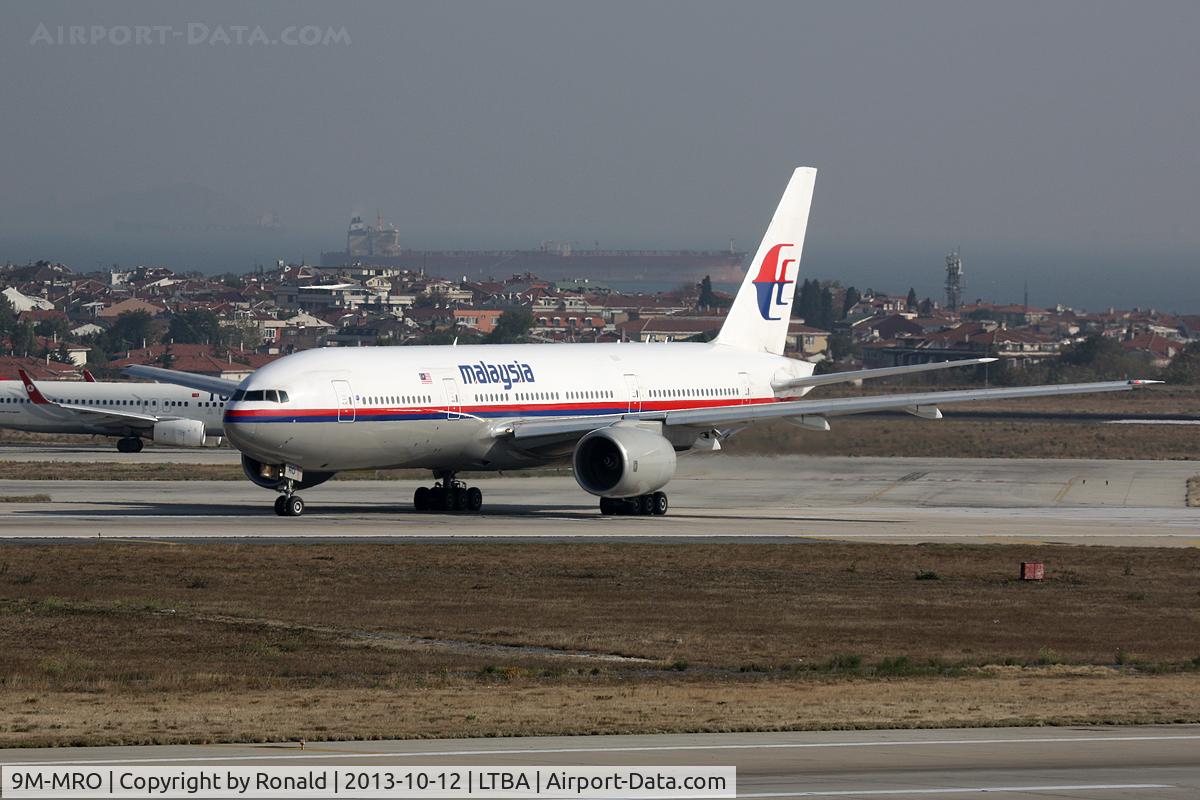
9M-MRO
MSN
28420/404
Year of Manufacture
2002
Operator
Malaysian Airlines System - MASDate
March 8, 2014 at 01:30 AM
Type
CRASHFlight Type
Scheduled Revenue Flight
Flight Phase
Flight
Crash Site
Lake, Sea, Ocean, River
Crash Location
Indian Ocean All World
Region
World • World
Narrative Report
On March 8, 2014 at 01:30 AM, Kuala Lumpur – Beijing experienced a crash involving Boeing 777-200, operated by Malaysian Airlines System - MAS, with the event recorded near Indian Ocean All World.
The flight was categorized as scheduled revenue flight and the reported phase was flight at a lake, sea, ocean, river crash site.
239 people were known to be on board, 239 fatalities were recorded, 0 survivors were identified or estimated. This corresponds to an estimated fatality rate of 100.0%.
Crew on board: 12, crew fatalities: 12, passengers on board: 227, passenger fatalities: 227, other fatalities: 0.
The Boeing 777-2H6ER took off from Kuala Lumpur Airport runway 32R at 0041LT bound for Beijing. Some 40 minutes later, while reaching FL350 over the Gulf of Thailand, radar contact was lost. At this time, the position of the aircraft was estimated 90 NM northeast of Kota Bharu, some 2 km from the IGARI waypoint. More than 4 days after the 'accident', no trace of the aircraft has been found. On the fifth day of operation, several countries were involved in the SAR operations, in the Gulf of Thailand, west of China Sea and on the Malacca Strait as well. All operations are performed in coordination with China, Thailand, Vietnam, Malaysia and Philippines. No distress call or any kind of message was sent by the crew. The last ACARS message was received at 0107LT and did not contain any error, failure or technical problems. At 0119LT was recorded the last radio transmission with the crew saying "All right, good night". At 0121LT, the transponder was switched off and the last radar contact was recorded at 0130LT. Several hypothesis are open and no trace of the aircraft nor the occupant have been found up to March 18, 2014. It is now understood the aircraft may flew several hours after it disappeared from radar screens, flying on an opposite direction from the prescribed flight plan, most probably to the south over the Indian Ocean. No such situation was ever noted by the B3A, so it is now capital to find both CVR & DFDR to explain the exact circumstances of this tragic event. Considering the actual situation, all scenarios are possible and all hypothesis are still open. On Mar 24, 2014, the Malaysian Prime Minister announced that according to new computations by the British AAIB based on new satellite data, there is no reasonable doubt that flight MH370 ended in the South Indian Ocean some 2,600 km west of Perth. Given the situation, the Malaysian Authorities believe that there is no chance to find any survivors among the 239 occupants. *************************** According to the testimony of 6 Swiss Citizens making a cruise between Perth and Singapore via Jakarta, the following evidences were spotted on March 12 while approaching the Sunda Strait: 1430LT - latitude 6° S, longitude 105° E, speed 17,7 knots: life jacket, food trays, papers, pieces of polystyrene, wallets, 1500LT: a huge white piece of 6 meters long to 2,5 meters wide with other debris, 1530LT: two masts one meter long with small flags on top, red and blue, 2030LT - latitude 5° S, longitude 107° E, speed 20,2 knots. This testimony was submitted by these 6 Swiss Citizens to the Chinese and Australian Authorities. On April 21, 2016, it was confirmed that this testimony was recorded by the Swiss Police and transmitted to the Swiss Transportation Safety Investigation Board (STSB), the State authority of the Swiss Confederation which has a mandate to investigate accidents and dangerous incidents involving trains, aircraft, inland navigation ships, and seagoing vessels. The link to the STSB is http://www.sust.admin.ch/en/index.html. *************************** On July 29, 2015, a flaperon was found on a beach of the French Island of La Réunion, in the Indian Ocean. It was quickly confirmed by the French Authorities (BEA) that the debris was part of the Malaysian B777. Other debris have been found since, in Mozambique and South Africa. On May 12, 2016, Australia's TSB reported that the part has been identified to be a "the decorative laminate as an interior panel from the main cabin. The location of a piano hinge on the part surface was consistent with a work-table support leg, utilised on the exterior of the MAB Door R1 (forward, right hand) closet panel". The ATSB reported that they were not able to identify any feature on the debris unique to MH-370, however, there is no record that such a laminate is being used by any other Boeing 777 customer. *************************** On September 15, 2016, the experts from the Australian Transportation Safety Bureau (ATSB) have completed their examination of the large piece of debris discovered on the island of Pemba, off the coast of Tanzania, on June 20, 2016. Based on thorough examination and analysis, ATSB with the concurrence of the MH370 Safety Investigation Team have identified the following: - Several part numbers, along with physical appearance, dimensions, and construction confirmed the piece to be an inboard section of a Boeing 777 outboard flap. - A date stamp associated with one of the part numbers indicated manufacture on January 23, 2002, which was consistent with the May 31, 2002 delivery date for MH370, - In addition to the Boeing part number, all identification stamps had a second 'OL' number that were unique identifiers relating to part construction, - The Italian part manufacturer has confirmed that all numbers located on the said part relates to the same serial number outboard flap that was shipped to Boeing as line number 404, - The manufacturer also confirmed that aircraft line number 404 was delivered to Malaysian Airlines and registered as 9M-MRO (MH370) As such, the experts have concluded that the debris, an outboard flap originated from the aircraft 9M-MRO, also known as flight MH370. Further examination of the debris will continue, in hopes that further evidence may be uncovered which may provide new insight into the circumstances surrounding flight MH370.
Aircraft reference details include registration 9M-MRO, MSN 28420/404, year of manufacture 2002.
Fatalities
Total
239
Crew
12
Passengers
227
Other
0
Crash Summary
The Boeing 777-2H6ER took off from Kuala Lumpur Airport runway 32R at 0041LT bound for Beijing. Some 40 minutes later, while reaching FL350 over the Gulf of Thailand, radar contact was lost. At this time, the position of the aircraft was estimated 90 NM northeast of Kota Bharu, some 2 km from the IGARI waypoint. More than 4 days after the 'accident', no trace of the aircraft has been found. On the fifth day of operation, several countries were involved in the SAR operations, in the Gulf of Thailand, west of China Sea and on the Malacca Strait as well. All operations are performed in coordination with China, Thailand, Vietnam, Malaysia and Philippines. No distress call or any kind of message was sent by the crew. The last ACARS message was received at 0107LT and did not contain any error, failure or technical problems. At 0119LT was recorded the last radio transmission with the crew saying "All right, good night". At 0121LT, the transponder was switched off and the last radar contact was recorded at 0130LT. Several hypothesis are open and no trace of the aircraft nor the occupant have been found up to March 18, 2014. It is now understood the aircraft may flew several hours after it disappeared from radar screens, flying on an opposite direction from the prescribed flight plan, most probably to the south over the Indian Ocean. No such situation was ever noted by the B3A, so it is now capital to find both CVR & DFDR to explain the exact circumstances of this tragic event. Considering the actual situation, all scenarios are possible and all hypothesis are still open. On Mar 24, 2014, the Malaysian Prime Minister announced that according to new computations by the British AAIB based on new satellite data, there is no reasonable doubt that flight MH370 ended in the South Indian Ocean some 2,600 km west of Perth. Given the situation, the Malaysian Authorities believe that there is no chance to find any survivors among the 239 occupants. *************************** According to the testimony of 6 Swiss Citizens making a cruise between Perth and Singapore via Jakarta, the following evidences were spotted on March 12 while approaching the Sunda Strait: 1430LT - latitude 6° S, longitude 105° E, speed 17,7 knots: life jacket, food trays, papers, pieces of polystyrene, wallets, 1500LT: a huge white piece of 6 meters long to 2,5 meters wide with other debris, 1530LT: two masts one meter long with small flags on top, red and blue, 2030LT - latitude 5° S, longitude 107° E, speed 20,2 knots. This testimony was submitted by these 6 Swiss Citizens to the Chinese and Australian Authorities. On April 21, 2016, it was confirmed that this testimony was recorded by the Swiss Police and transmitted to the Swiss Transportation Safety Investigation Board (STSB), the State authority of the Swiss Confederation which has a mandate to investigate accidents and dangerous incidents involving trains, aircraft, inland navigation ships, and seagoing vessels. The link to the STSB is http://www.sust.admin.ch/en/index.html. *************************** On July 29, 2015, a flaperon was found on a beach of the French Island of La Réunion, in the Indian Ocean. It was quickly confirmed by the French Authorities (BEA) that the debris was part of the Malaysian B777. Other debris have been found since, in Mozambique and South Africa. On May 12, 2016, Australia's TSB reported that the part has been identified to be a "the decorative laminate as an interior panel from the main cabin. The location of a piano hinge on the part surface was consistent with a work-table support leg, utilised on the exterior of the MAB Door R1 (forward, right hand) closet panel". The ATSB reported that they were not able to identify any feature on the debris unique to MH-370, however, there is no record that such a laminate is being used by any other Boeing 777 customer. *************************** On September 15, 2016, the experts from the Australian Transportation Safety Bureau (ATSB) have completed their examination of the large piece of debris discovered on the island of Pemba, off the coast of Tanzania, on June 20, 2016. Based on thorough examination and analysis, ATSB with the concurrence of the MH370 Safety Investigation Team have identified the following: - Several part numbers, along with physical appearance, dimensions, and construction confirmed the piece to be an inboard section of a Boeing 777 outboard flap. - A date stamp associated with one of the part numbers indicated manufacture on January 23, 2002, which was consistent with the May 31, 2002 delivery date for MH370, - In addition to the Boeing part number, all identification stamps had a second 'OL' number that were unique identifiers relating to part construction, - The Italian part manufacturer has confirmed that all numbers located on the said part relates to the same serial number outboard flap that was shipped to Boeing as line number 404, - The manufacturer also confirmed that aircraft line number 404 was delivered to Malaysian Airlines and registered as 9M-MRO (MH370) As such, the experts have concluded that the debris, an outboard flap originated from the aircraft 9M-MRO, also known as flight MH370. Further examination of the debris will continue, in hopes that further evidence may be uncovered which may provide new insight into the circumstances surrounding flight MH370.
Occupants & Outcome
Crew On Board
12
Passengers On Board
227
Estimated Survivors
0
Fatality Rate
100.0%
Known people on board: 239
Operational Details
Schedule / Flight
Kuala Lumpur – Beijing
Operator
Malaysian Airlines System - MASFlight Type
Scheduled Revenue Flight
Flight Phase
Flight
Crash Site
Lake, Sea, Ocean, River
Region / Country
World • World
Aircraft Details
Similar Plane Crashes
Compagnie Générale Transaérienne - CGT
Nieuport-Delage NiD-30
The pilot, sole on board, departed Paris-Le Bourget on a mail flight to Hounslow Heath, London. While cruising over The Channel, he encountered thick fog when the airplane crashed in the sea in unknown circumstances. The pilot was killed.
KLM Royal Dutch Airlines - Koninklijke Luchtvaart Maatschappij
Fokker F3
The aircraft departed Croydon Airport at 1043LT on a regular schedule service to Amsterdam with an intermediate stop in Rotterdam, carrying two passengers and one pilot. En route, the pilot encountered technical problems and diverted to Lympne Airport, Kent. After several repairs were made, he continued the flight with an unserviceable radio. While cruising over the North Sea (between The Channel and the North Sea), the pilot encountered foggy conditions when the aircraft crashed in unknown circumstances in the sea. As the aircraft failed to arrive in Rotterdam, SAR operations were initiated but no trace of the aircraft nor the three occupants was found. Crew: Adriaan Pijl, pilot. Passengers: Mr. W. J. van Hien, Mr. C. Modderman.
Regia Aeronautica
Dornier Do J Wal
The crew departed Pisa, Italy, last 25 July to perform a transatlantic flight to Canada on behalf of the 'Commissariato Aeronautica', the ancient name of the Italian Air Force. The seaplane made stops in Saint-Raphaël, south of France, Lausanne (quai of Ouchy on Lake of Geneva), Strasbourg, Rotterdam, Hull, Stromness (Orkneys Islands), Feroe Islands and Reykjavik. While flying over the Sea of Labrador, some 180 km south of Cape Farewell, Greenland, the crew encountered engine problems and elected to make an emergency landing. The twin engine seaplane landed safely and the crew sent several mayday message. All five occupants were later rescued and evacuated by the crew of 'USS Richmond' which deviated from his route to the accident site. In a rough sea, the seaplane sank later and was lost and not recovered. Crew: Lt Antonio Locatelli, pilot, Lt Crosio, Lt Marescalchi, Mr. Braccini, flight engineer, Mr. Falcinelli, flight engineer.
Compagnie Générale d'Entreprises Aéronautiques - CGEA
Lioré-et-Olivier LeO H-13
En route from Oran to Alicante, the crew was forced to make an emergency landing following an engine failure. The crew was rescued few hours later and the aircraft sank and was lost.
Compagnie Générale d'Entreprises Aéronautiques - CGEA
Lioré-et-Olivier LeO H-13
En route from Alicante to Oran, a structural failure occurred on the buckle, forcing the crew to ditch the aircraft. The aircraft sank and both crew members (who were slightly injured) were rescued by the crew of the British boat named 'Egyptian'. Crew: Léon Givon, pilot, François Urvoy, mechanic.
Compagnie Générale d'Entreprises Aéronautiques - CGEA
Lioré-et-Olivier LeO H-13
The crew was performing a mail flight from Oran to Alicante when an engine failed while overflying the Mediterranean Sea. The crew ditch the aircraft in the sea. Both pilots were rescued 15 hours later by a the crew of a Spanish speedboat. The aircraft sank and was lost.