
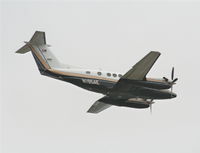
N195AE
Flight / Schedule
N195AE
Aircraft
Beechcraft MC-12W LibertyRegistration
N195AE
MSN
FA-195
Year of Manufacture
1989
Operator
United States ArmyDate
January 9, 2014 at 12:00 AM
Type
CRASHFlight Type
Survey / Patrol / Reconnaissance
Flight Phase
Flight
Crash Site
Mountains
Crash Location
Afghanistan All Afghanistan
Region
Asia • Afghanistan
Narrative Report
On January 9, 2014 at 12:00 AM, N195AE experienced a crash involving Beechcraft MC-12W Liberty, operated by United States Army, with the event recorded near Afghanistan All Afghanistan.
The flight was categorized as survey / patrol / reconnaissance and the reported phase was flight at a mountains crash site.
3 people were known to be on board, 3 fatalities were recorded, 0 survivors were identified or estimated. This corresponds to an estimated fatality rate of 100.0%.
Crew on board: 2, crew fatalities: 2, passengers on board: 1, passenger fatalities: 1, other fatalities: 0.
The twin engine aircraft was performing a special mission with a crew of two and a member of the ISAF on board. The accident occurred in unknown circumstances somewhere in the east part of Afghanistan. The aircraft was destroyed and all three occupants were killed. There are no indications that the aircraft was brought down by enemy fire, said a Defense official. It was later reported that the airplane involved was completing an Air Medium-Altitude Reconnaissance and Surveillance System (MARSS) mission.
Aircraft reference details include registration N195AE, MSN FA-195, year of manufacture 1989.
Fatalities
Total
3
Crew
2
Passengers
1
Other
0
Crash Summary
The twin engine aircraft was performing a special mission with a crew of two and a member of the ISAF on board. The accident occurred in unknown circumstances somewhere in the east part of Afghanistan. The aircraft was destroyed and all three occupants were killed. There are no indications that the aircraft was brought down by enemy fire, said a Defense official. It was later reported that the airplane involved was completing an Air Medium-Altitude Reconnaissance and Surveillance System (MARSS) mission.
Occupants & Outcome
Crew On Board
2
Passengers On Board
1
Estimated Survivors
0
Fatality Rate
100.0%
Known people on board: 3
Operational Details
Operator
United States ArmyFlight Type
Survey / Patrol / Reconnaissance
Flight Phase
Flight
Crash Site
Mountains
Region / Country
Asia • Afghanistan
Aircraft Details
Similar Plane Crashes
United States Army
De Havilland DHC-2 Beaver
En route from Ellensburg to the McChord AFB, the aircraft crashed in unknown circumstances in a mountainous area covered by snow. As the aircraft failed to arrive at destination, SAR operations were conducted but eventually suspended few days later as no trace of the aircraft nor the crew was found. The following summer, walkers found the wreckage in an isolated area. Crew: Cpt Wade L. Shankle Jr. Passenger: John A. Ardussi. Source & photos: http://washingtonwreckchasing.blogspot.ch/2009_06_01_archive.html
Iran Air
Douglas C-47 Skytrain (DC-3)
Flight IR123 was a scheduled international cargo flight from Kabul, Afghanistan to Tehran, Iran. The co-pilot was in the left-hand seat and pilot flying at the commencement of the takeoff run. The aircraft was cleared for takeoff on runway 29 at 13:13. When accelerating for takeoff the pilot-in-command noticed that the propeller of the no. 1 engine was overspeeding and surging as high as 3300 rpm. As the aircraft approached an indicated airspeed of about 80 kts the captain took command. He noticed that the aircraft was headed to the left away from the runway centreline towards three runway lights in a concrete footing at the left edge of the runway. To avoid a possible collision with these lights the captain applied elevator control and lifted the aircraft off the runway. The overspeeding propeller condition did not subside although he followed the procedure prescribed in the operations manual for corrective action. The flight path was about 30 to 45° to the left of the runway and in the general direction of the Kabul Airport terminal building so the captain attempted to turn the aircraft further to the left to avoid collision with the building. About 325 ft from the south edge of runway 29 the left wing contacted the ground and the aircraft crashed.
United States Army
De Havilland DHC-3 Otter
While cruising at an altitude of 3,600 meters in poor weather conditions, the single engine aircraft crashed in the Zagros Mountains, some 500 km south of Tehran. The wreckage was found few days later and two passengers were evacuated seriously wounded by low temperatures. The three other occupants were killed. Crew: Maj Carter, pilot. † Passengers: Col Walter R. Johnson, † Cpt Daniel Knotts, † Col Vann, Col John Porter.
United States Army
De Havilland DHC-3 Otter
The departure from Hàng B<U+1EE9>c was attempted in gusty winds and the single engine airplane crashed during takeoff. The pilot, sole on board, was killed.
United States Army
De Havilland DHC-4 Caribou
Crashed in unknown circumstances in the region of A Lu<U+1EDB>i while on a supply mission. The crew fate remains unknown and the exact date of the mishap as well (somewhere during August 1963).
TMA of Lebanon - Trans Mediterranean Airways
Douglas C-54 Skymaster
The aircraft was on a non-scheduled international cargo flight from Beirut, Lebanon to Kabul, Afghanistan via Kuwait, carrying a crew of three. The trip to Kuwait was uneventful, and it arrived there at 0036 hours GMT on 12 December. Departure from Kuwait for Kabul was at 0256 hours and the flight reported passing Kandahar at 0838 and Kalat at 0900 flying at flight level 110. While en route the aircraft was provided with the Kandahar and Kabul weather. At 0942 hours it reported passing Ghazni at 0940, flying at flight level 150 and estimated its arrival time at Kabul as 10 10 hours. However, at 0958 (i. e. 12 minutes before ETA) it reported overhead Kabul and requested the latest weather situation which was provided. As the aircraft could not land at Kabul because of the weather conditions it reported at 0959 hours that it was diverting to Lahore. Shortly thereafter it reported it was proceeding to Zahedan via Ghazni (ETA 1025), Kandahar (ETA 1130) Zahedan (ETA 13 15). It would maintain flight level 150 to Ghazni, 130 to Kandahar and 110 to Zahedan. At 1003 hours the Kabul tower passed the Kandahar weather to the flight and 5 minutes later the flight reported it was 25 miles out from Kabul, at flight level 150. The aircraft was then cleared by Kabul tower to route frequency and nothing further was heard from it. The wreckage of the aircraft was first sighted on 16 August 1964, after the snow had melted, at an elevation of 13 940 ft amsl in the Koh-i-Safid Mountains 50 NM west of Ghazni and 42 NM from the approved air route. The coordinates of the accident site were estimated to be 33° 37' N 67° 35' E. The time of the accident was some time after 1015 hours GMT on 12 December 1963. The wreckage was found by Afghan soldiers on 16 August 1964.