
Guernsey - Jersey
Flight / Schedule
Guernsey - Jersey
Aircraft
ATR42-300Registration
G-DRFC
MSN
007
Year of Manufacture
1986
Operator
Blue IslandsDate
June 16, 2012 at 08:23 AM
Type
CRASHFlight Type
Scheduled Revenue Flight
Flight Phase
Landing (descent or approach)
Crash Site
Airport (less than 10 km from airport)
Crash Location
Jersey Channel Islands
Region
Europe • United Kingdom
Crash Cause
Technical failure
Narrative Report
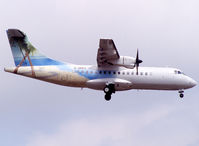
On June 16, 2012 at 08:23 AM, Guernsey - Jersey experienced a crash involving ATR42-300, operated by Blue Islands, with the event recorded near Jersey Channel Islands.
The flight was categorized as scheduled revenue flight and the reported phase was landing (descent or approach) at a airport (less than 10 km from airport) crash site.
43 people were known to be on board, 0 fatalities were recorded, 43 survivors were identified or estimated. This corresponds to an estimated fatality rate of 0.0%.
Crew on board: 3, crew fatalities: 0, passengers on board: 40, passenger fatalities: 0, other fatalities: 0.
The listed crash cause is technical failure. The crew, comprising a commander, co-pilot and cabin crewmember, reported for duty at 0620 hrs at Guernsey Airport. The commander was conducting line training of the co-pilot, a first officer who had recently joined the companyThe first sector was to be from Guernsey to Jersey. No problems were identified during the pre-flight preparation and the aircraft departed on time at 0705 hrs, with the commander acting as handling pilot. The short flight was without incident and the weather for landing was reported as good, with the wind from 210° at 16 kt, FEW cloud at 2,000 ft and visibility in excess of 10 km. The commander elected to carry out a visual approach to Runway 27 at Jersey, using a planned approach speed of 107 kt and flap 30 selected for landing. During the approach, the gear was selected down and the flight crew confirmed the three green ‘gear safe’ indication lights were illuminated, indicating that the gear was locked in the down position. The commander reported that both the approach and touchdown seemed normal, with the crosswind from the left resulting in the left main gear touching first. Just after touchdown both pilots heard a noise and the commander stated the aircraft appeared to settle slightly differently from usual. This made him believe that a tyre had burst. The cabin crew member also heard a noise after touchdown which she too thought was from a tyre bursting. The commander selected ground idle and partial reverse pitch and, as the aircraft decelerated through 70 kt, the co-pilot took over control of the ailerons, as per standard procedures, to allow the commander to take control of the steering tiller. The co-pilot reported that despite applying corrective inputs the aircraft continued rolling to the left. A member of ground operations staff, situated at Holding Point E, reported to the tower controller that the left landing gear leg of the aircraft did not appear to be down properly as it passed him. The aircraft continued to quickly roll to the left until the left wingtip and propeller contacted the runway. The aircraft remained on the runway, rapidly coming to a halt to the left of the centreline, approximately abeam Holding Point D. Both propellers continued to rotate and the commander selected the condition levers to the fuel shutoff position and pulled the fire handles to shut both engines down. The tower controller, seeing the incident, pressed the crash alarm and airfield emergency services were quickly in attendance.
Aircraft reference details include registration G-DRFC, MSN 007, year of manufacture 1986.
Fatalities
Total
0
Crew
0
Passengers
0
Other
0
Crash Summary
The crew, comprising a commander, co-pilot and cabin crewmember, reported for duty at 0620 hrs at Guernsey Airport. The commander was conducting line training of the co-pilot, a first officer who had recently joined the companyThe first sector was to be from Guernsey to Jersey. No problems were identified during the pre-flight preparation and the aircraft departed on time at 0705 hrs, with the commander acting as handling pilot. The short flight was without incident and the weather for landing was reported as good, with the wind from 210° at 16 kt, FEW cloud at 2,000 ft and visibility in excess of 10 km. The commander elected to carry out a visual approach to Runway 27 at Jersey, using a planned approach speed of 107 kt and flap 30 selected for landing. During the approach, the gear was selected down and the flight crew confirmed the three green ‘gear safe’ indication lights were illuminated, indicating that the gear was locked in the down position. The commander reported that both the approach and touchdown seemed normal, with the crosswind from the left resulting in the left main gear touching first. Just after touchdown both pilots heard a noise and the commander stated the aircraft appeared to settle slightly differently from usual. This made him believe that a tyre had burst. The cabin crew member also heard a noise after touchdown which she too thought was from a tyre bursting. The commander selected ground idle and partial reverse pitch and, as the aircraft decelerated through 70 kt, the co-pilot took over control of the ailerons, as per standard procedures, to allow the commander to take control of the steering tiller. The co-pilot reported that despite applying corrective inputs the aircraft continued rolling to the left. A member of ground operations staff, situated at Holding Point E, reported to the tower controller that the left landing gear leg of the aircraft did not appear to be down properly as it passed him. The aircraft continued to quickly roll to the left until the left wingtip and propeller contacted the runway. The aircraft remained on the runway, rapidly coming to a halt to the left of the centreline, approximately abeam Holding Point D. Both propellers continued to rotate and the commander selected the condition levers to the fuel shutoff position and pulled the fire handles to shut both engines down. The tower controller, seeing the incident, pressed the crash alarm and airfield emergency services were quickly in attendance.
Cause: Technical failure
Occupants & Outcome
Crew On Board
3
Passengers On Board
40
Estimated Survivors
43
Fatality Rate
0.0%
Known people on board: 43
Operational Details
Schedule / Flight
Guernsey - Jersey
Operator
Blue IslandsFlight Type
Scheduled Revenue Flight
Flight Phase
Landing (descent or approach)
Crash Site
Airport (less than 10 km from airport)
Region / Country
Europe • United Kingdom
Aircraft Details
Similar Plane Crashes
Handley Page Aircraft Company Ltd
Handley Page V/1500
Assembled at Cricklewood Airfield in May 1918, the aircraft departed Cricklewood for its 13th test flight, carrying six crew members. Shortly after takeoff, while climbing to a height of about 700-800 feet, all four engines stopped. The pilot elected to return for an emergency landing when the aircraft stalled and crashed in a field located in front of 21 Garrick Avenue in Golders Green, bursting into flames. Colonel Ogilvie, who was seating in the tail gunner position at the back of the plane, survived, while all five other occupants were killed. Crew: Cpt Vernon Earl George Busby, pilot, † Mr. Bertram G. Cooper, † Mr. R. P. Cooper, † Mr. W. H. Hathaway, † Mr. J. W. Windebank, † Colonel Ogilvie.
Marine Aeroplane Depot
Fairey III
The pilot departed Isle of Grain on a delivery flight to Glasgow-Renfrew Airport. On approach to RAF Usworth (RAF Hylton), he elected to make a go-around when the aircraft lost height and crashed. The aircraft was destroyed and the pilot, Captain Arthur Leslie Simms, was killed.
Royal Air Force - RAF
De Havilland DH.6
The crew was completing a local training flight at RAF Seaton Carew when the aircraft entered a spin and crashed in a field, bursting into flames. Both occupants were killed. Crew: Cpt Charles David Danby, pilot, 1st Class E. A. Bannister, mechanic.
Royal Air Force - RAF
Handley Page H.P.12
The aircraft departed Castle Bromwich for a test flight, carrying five engineers and two crew members. En route, the twin engine aircraft suffered technical problems with a wing, lost height and crashed in a field located in Maxstoke. The aircraft was destroyed and all seven occupants were killed. Crew: Lt Robert Edward Macbeth, Lt Frederick James Bravery, 1st Air Mechanic James Benjamn May, 2nd Air Mechanic Albert J. Winrow, 2nd Air Mechanic H. Simmonds, 3rd Air Mechanic Charles William Offord, 3rd George Greenland.
Royal Air Force - RAF
Blackburn R.T.1 Kangaroo
On final approach in bad visibility, aircraft was too low. It struck the ground short of runway and crashed. Both occupants were injured. Crew was performing a training flight on behalf of the 246th Squadron.
Royal Air Force - RAF
De Havilland DH.9
The pilot tried to return to his base but due to low visibility by night, he lost his orientation. He elected to make an emergency landing in an open field but the aircraft hit a tree and crashed. The pilot was injured.