
Dubai - Kandahar
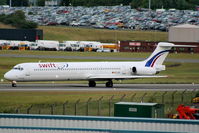
Flight / Schedule
Dubai - Kandahar
Aircraft
McDonnell Douglas MD-83Registration
EC-JJS
MSN
49793/1656
Year of Manufacture
1989
Operator
SwiftairDate
January 24, 2012 at 08:28 AM
Type
CRASHFlight Type
Charter/Taxi (Non Scheduled Revenue Flight)
Flight Phase
Landing (descent or approach)
Crash Site
Airport (less than 10 km from airport)
Crash Location
Kandahar Kandahar
Region
Asia • Afghanistan
Coordinates
31.6123°, 65.7013°
Crash Cause
Human factor
Narrative Report
On January 24, 2012 at 08:28 AM, Dubai - Kandahar experienced a crash involving McDonnell Douglas MD-83, operated by Swiftair, with the event recorded near Kandahar Kandahar.
The flight was categorized as charter/taxi (non scheduled revenue flight) and the reported phase was landing (descent or approach) at a airport (less than 10 km from airport) crash site.
91 people were known to be on board, 0 fatalities were recorded, 91 survivors were identified or estimated. This corresponds to an estimated fatality rate of 0.0%.
Crew on board: 5, crew fatalities: 0, passengers on board: 86, passenger fatalities: 0, other fatalities: 0.
The listed crash cause is human factor. On Tuesday, 24 January 2012, a McDonnell Douglas MD-83, registration EC-JJS and operated by Swiftair, took off from the Dubai Airport (United Arab Emirates) at 02:08 UTC on a scheduled flight to the Kandahar Airport (Afghanistan). Its callsign was SWT094 and there were 86 passengers (one of them a company mechanic), three flight attendants and two cockpit crew onboard. Swiftair, S.A. was operating this regularly scheduled passenger flight under an ACMI arrangement with the South African company Gryphon Airlines. The crew was picked up at its usual hotel in the emirate of Ras al-Khaimah (United Arab Emirates) at 21:00. The airplane was parked in the Ras al-Khaimah airport and had to be flown empty to the Dubai Airport. This flight departed at 00:20 UTC en route to Dubai. Once there, an agent for Gryphon Airlines gave the crew the documentation for the flight to Kandahar. They went through customs at the Dubai Airport, boarded the passengers and the cargo and refueled the airplane with enough fuel to make the return the flight, a typical practice so as to avoid refueling in Kandahar. The airplane took off from runway 30R at the Dubai Airport at 02:08 on standard instrument departure RIKET2D and climbed to flight level FL290. The first officer was the pilot flying. At 03:42, while over SERKA, they were transferred to Kabul control, which instructed them to descend to FL280. The crew reported its ISAF callsign (ISF39RT) to this ATS station, which allowed the aircraft to fly over Afghan airspace, and entered the new stipulated squawk code. Kabul Control instructed the crew to follow some radar vectors that took them to point SODAS, where they were transferred to Kandahar Control at 03:46. The crew reduced the airspeed to 250 kt above this point. Kandahar Control cleared them for an RNAV (GPS) approach to runway 05, providing a direct vector to point FALOD (the IAF), and to descend to 6,000 ft. The weather information provided on the ATIS “F” broadcast was runway in use 05, wind from 060º at 17 kt gusting to 24 kt, visibility 1,200 m, scattered clouds at 2,700 ft and broken clouds at 3,000 ft, temperature 1 ºC, dewpoint -7 ºC and QNH 30.06 in Hg (1,018 mbar). This information was practically the same as that radioed to the crew by the Kandahar control tower a few minutes before landing: wind from 060 at 15 kt gusting to 21 kt. They reached point FALOD (IAF) under cloud cover (and thus in IMC conditions). They did not exit the clouds until 1,500 ft before minimums which, for this approach, according to the associated chart, was an altitude of 3,700 ft, or 394 ft AGL. They established visual contact with the runway 500 ft above minimums and noted that they were a little right of the runway centerline. Since the captain had more operational experience at the destination airfield, he decided to take over the controls and fly the last phase of the approach maneuver. The PAPI was out of service, meaning that in final approach they only had visual references to the runway and over the ground. During short final they corrected the deviation from the runway centerline by adjusting their path from right to left. They landed at 03:58. During the flare, the crew noticed the airplane was shifting to the left, threatening to take them off the runway, as a result of which the captain applied a right roll angle. This caused the right wing tip to strike the ground before the wheels made contact with the ground. The captain regarded the maneuver as a hard landing, although the first officer thought they might have struck the runway. The autopilot was engaged until visual contact was established with the runway and the auto-throttle until the landing. On exiting the runway, the airport control tower personnel (who had witnessed the contact with the ground) ordered the crew to stop and informed them of the damage they had seen during the landing. They dispatched the emergency services (firefighters), which forced them to turn off their engines. Once it was confirmed that there was no fuel leak or damage to the wheels or brakes, they allowed the crew to restart the engines and proceed to the stand. The wing made contact with the ground some 20 m prior to the threshold, resulting in five threshold lights being destroyed by the aircraft and in damage to the aircraft’s right wing. According to the crew’s statement, the passengers were not really aware of the contact between the wing and the ground and they were subsequently disembarked normally.
Aircraft reference details include registration EC-JJS, MSN 49793/1656, year of manufacture 1989.
Geospatial coordinates for this crash are approximately 31.6123°, 65.7013°.
Fatalities
Total
0
Crew
0
Passengers
0
Other
0
Crash Summary
On Tuesday, 24 January 2012, a McDonnell Douglas MD-83, registration EC-JJS and operated by Swiftair, took off from the Dubai Airport (United Arab Emirates) at 02:08 UTC on a scheduled flight to the Kandahar Airport (Afghanistan). Its callsign was SWT094 and there were 86 passengers (one of them a company mechanic), three flight attendants and two cockpit crew onboard. Swiftair, S.A. was operating this regularly scheduled passenger flight under an ACMI arrangement with the South African company Gryphon Airlines. The crew was picked up at its usual hotel in the emirate of Ras al-Khaimah (United Arab Emirates) at 21:00. The airplane was parked in the Ras al-Khaimah airport and had to be flown empty to the Dubai Airport. This flight departed at 00:20 UTC en route to Dubai. Once there, an agent for Gryphon Airlines gave the crew the documentation for the flight to Kandahar. They went through customs at the Dubai Airport, boarded the passengers and the cargo and refueled the airplane with enough fuel to make the return the flight, a typical practice so as to avoid refueling in Kandahar. The airplane took off from runway 30R at the Dubai Airport at 02:08 on standard instrument departure RIKET2D and climbed to flight level FL290. The first officer was the pilot flying. At 03:42, while over SERKA, they were transferred to Kabul control, which instructed them to descend to FL280. The crew reported its ISAF callsign (ISF39RT) to this ATS station, which allowed the aircraft to fly over Afghan airspace, and entered the new stipulated squawk code. Kabul Control instructed the crew to follow some radar vectors that took them to point SODAS, where they were transferred to Kandahar Control at 03:46. The crew reduced the airspeed to 250 kt above this point. Kandahar Control cleared them for an RNAV (GPS) approach to runway 05, providing a direct vector to point FALOD (the IAF), and to descend to 6,000 ft. The weather information provided on the ATIS “F” broadcast was runway in use 05, wind from 060º at 17 kt gusting to 24 kt, visibility 1,200 m, scattered clouds at 2,700 ft and broken clouds at 3,000 ft, temperature 1 ºC, dewpoint -7 ºC and QNH 30.06 in Hg (1,018 mbar). This information was practically the same as that radioed to the crew by the Kandahar control tower a few minutes before landing: wind from 060 at 15 kt gusting to 21 kt. They reached point FALOD (IAF) under cloud cover (and thus in IMC conditions). They did not exit the clouds until 1,500 ft before minimums which, for this approach, according to the associated chart, was an altitude of 3,700 ft, or 394 ft AGL. They established visual contact with the runway 500 ft above minimums and noted that they were a little right of the runway centerline. Since the captain had more operational experience at the destination airfield, he decided to take over the controls and fly the last phase of the approach maneuver. The PAPI was out of service, meaning that in final approach they only had visual references to the runway and over the ground. During short final they corrected the deviation from the runway centerline by adjusting their path from right to left. They landed at 03:58. During the flare, the crew noticed the airplane was shifting to the left, threatening to take them off the runway, as a result of which the captain applied a right roll angle. This caused the right wing tip to strike the ground before the wheels made contact with the ground. The captain regarded the maneuver as a hard landing, although the first officer thought they might have struck the runway. The autopilot was engaged until visual contact was established with the runway and the auto-throttle until the landing. On exiting the runway, the airport control tower personnel (who had witnessed the contact with the ground) ordered the crew to stop and informed them of the damage they had seen during the landing. They dispatched the emergency services (firefighters), which forced them to turn off their engines. Once it was confirmed that there was no fuel leak or damage to the wheels or brakes, they allowed the crew to restart the engines and proceed to the stand. The wing made contact with the ground some 20 m prior to the threshold, resulting in five threshold lights being destroyed by the aircraft and in damage to the aircraft’s right wing. According to the crew’s statement, the passengers were not really aware of the contact between the wing and the ground and they were subsequently disembarked normally.
Cause: Human factor
Occupants & Outcome
Crew On Board
5
Passengers On Board
86
Estimated Survivors
91
Fatality Rate
0.0%
Known people on board: 91
Operational Details
Schedule / Flight
Dubai - Kandahar
Operator
SwiftairFlight Type
Charter/Taxi (Non Scheduled Revenue Flight)
Flight Phase
Landing (descent or approach)
Crash Site
Airport (less than 10 km from airport)
Region / Country
Asia • Afghanistan
Aircraft Details
Similar Plane Crashes
Iran Air
Douglas C-47 Skytrain (DC-3)
Flight IR123 was a scheduled international cargo flight from Kabul, Afghanistan to Tehran, Iran. The co-pilot was in the left-hand seat and pilot flying at the commencement of the takeoff run. The aircraft was cleared for takeoff on runway 29 at 13:13. When accelerating for takeoff the pilot-in-command noticed that the propeller of the no. 1 engine was overspeeding and surging as high as 3300 rpm. As the aircraft approached an indicated airspeed of about 80 kts the captain took command. He noticed that the aircraft was headed to the left away from the runway centreline towards three runway lights in a concrete footing at the left edge of the runway. To avoid a possible collision with these lights the captain applied elevator control and lifted the aircraft off the runway. The overspeeding propeller condition did not subside although he followed the procedure prescribed in the operations manual for corrective action. The flight path was about 30 to 45° to the left of the runway and in the general direction of the Kabul Airport terminal building so the captain attempted to turn the aircraft further to the left to avoid collision with the building. About 325 ft from the south edge of runway 29 the left wing contacted the ground and the aircraft crashed.
TMA of Lebanon - Trans Mediterranean Airways
Douglas C-54 Skymaster
The aircraft was on a non-scheduled international cargo flight from Beirut, Lebanon to Kabul, Afghanistan via Kuwait, carrying a crew of three. The trip to Kuwait was uneventful, and it arrived there at 0036 hours GMT on 12 December. Departure from Kuwait for Kabul was at 0256 hours and the flight reported passing Kandahar at 0838 and Kalat at 0900 flying at flight level 110. While en route the aircraft was provided with the Kandahar and Kabul weather. At 0942 hours it reported passing Ghazni at 0940, flying at flight level 150 and estimated its arrival time at Kabul as 10 10 hours. However, at 0958 (i. e. 12 minutes before ETA) it reported overhead Kabul and requested the latest weather situation which was provided. As the aircraft could not land at Kabul because of the weather conditions it reported at 0959 hours that it was diverting to Lahore. Shortly thereafter it reported it was proceeding to Zahedan via Ghazni (ETA 1025), Kandahar (ETA 1130) Zahedan (ETA 13 15). It would maintain flight level 150 to Ghazni, 130 to Kandahar and 110 to Zahedan. At 1003 hours the Kabul tower passed the Kandahar weather to the flight and 5 minutes later the flight reported it was 25 miles out from Kabul, at flight level 150. The aircraft was then cleared by Kabul tower to route frequency and nothing further was heard from it. The wreckage of the aircraft was first sighted on 16 August 1964, after the snow had melted, at an elevation of 13 940 ft amsl in the Koh-i-Safid Mountains 50 NM west of Ghazni and 42 NM from the approved air route. The coordinates of the accident site were estimated to be 33° 37' N 67° 35' E. The time of the accident was some time after 1015 hours GMT on 12 December 1963. The wreckage was found by Afghan soldiers on 16 August 1964.
Ariana Afghan Airlines
Douglas DC-3
Crashed in unknown circumstances in a mountainous area located in the Logar Province. The exact date of the mishap remains unknown. The airplane crashed sometime in the year 1963.
Ariana Afghan Airlines
Douglas C-47 Skytrain (DC-3)
Two Ariana Afghan Airlines aircraft collided in unknown circumstances at Kabul Airport. A C-47 registered YA-AAB was damaged beyond repair while a DC-6 registered YA-DAN was repaired. There were no injuries.
Bakhtar Afghan Airlines
Yakovlev Yak-40
On final approach to Khost Airport, the crew failed to realize his altitude was too low. On short final, the three engine airplane struck tree tops located 154 meters short of runway 24 threshold. After impact, the airplane lost height and landed hard. The crew was able to stop the aircraft normally and as there were no injuries, the aircraft was considered as damaged beyond repair.
Bakhtar Afghan Airlines
De Havilland DHC-6 Twin Otter
At liftoff at Bamyan Airport, the twin engine airplane went out of control and crashed. Both pilots and two passengers were killed while 15 other occupants were injured. All passengers were US and Canadian citizens.