
Belfast - Birmingham
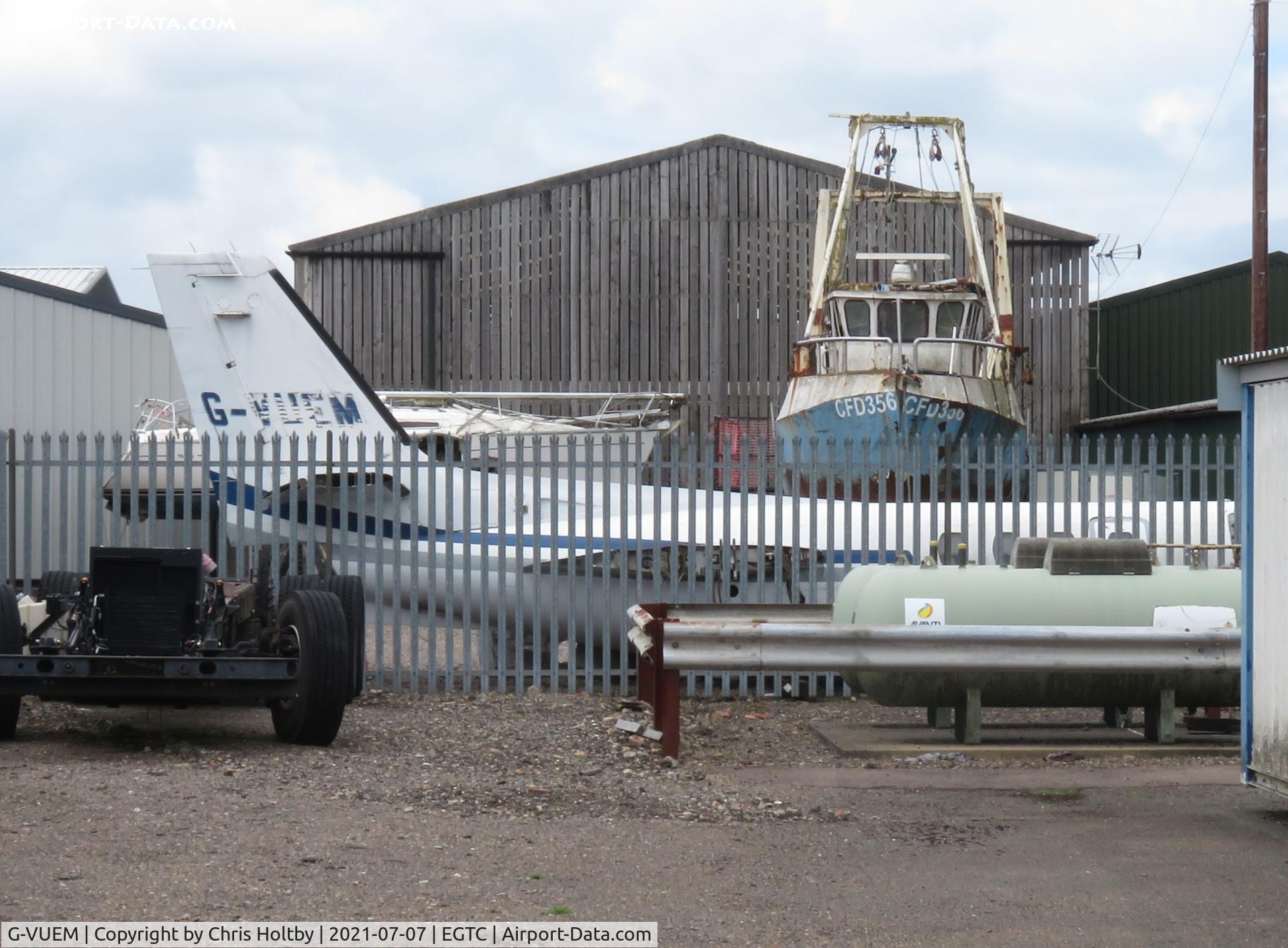
Flight / Schedule
Belfast - Birmingham
Aircraft
Cessna 501 Citation IRegistration
G-VUEM
MSN
501-0178
Year of Manufacture
1981
Operator
Frandley Aviation PartnershipDate
November 19, 2010 at 03:35 PM
Type
CRASHFlight Type
Ambulance
Flight Phase
Landing (descent or approach)
Crash Site
Airport (less than 10 km from airport)
Crash Location
Birmingham West Midlands
Region
Europe • United Kingdom
Coordinates
52.4783°, -1.8983°
Crash Cause
Human factor
Narrative Report
On November 19, 2010 at 03:35 PM, Belfast - Birmingham experienced a crash involving Cessna 501 Citation I, operated by Frandley Aviation Partnership, with the event recorded near Birmingham West Midlands.
The flight was categorized as ambulance and the reported phase was landing (descent or approach) at a airport (less than 10 km from airport) crash site.
2 people were known to be on board, 0 fatalities were recorded, 2 survivors were identified or estimated. This corresponds to an estimated fatality rate of 0.0%.
Crew on board: 2, crew fatalities: 0, passengers on board: 0, passenger fatalities: 0, other fatalities: 0.
The listed crash cause is human factor. The flight crew reported for duty at Liverpool Airport at 0845 hrs. Their original task was to fly to Belfast City Airport, collect a transplant organ, and take it to Cambridge Airport. However, on their arrival at Belfast the transfer was no longer required, so they were given a new task to fly to Belfast Aldergrove Airport and collect an organ to carry to Birmingham Airport. The aircraft departed Belfast Aldergrove at 1450 hrs with the co-pilot as pilot flying. The flight was uneventful and the aircraft was given a radar vector to intercept the ILS for a straight-in approach to Runway 15 at Birmingham. The Runway 15 ILS course is 149°M. The autopilot was engaged and the aircraft was flying on a track of 135°M, 13 nm from the touchdown zone and at a groundspeed of 254 kt, when it crossed the localiser centreline. The aircraft then turned right onto a corrective track but once again passed through the localiser course. Further corrections were made and the aircraft passed through the localiser once more before becoming established at 5 nm. The co-pilot later reported that, because the autopilot was not capturing the localiser, he had disconnected it and flown the approach manually. When the aircraft was at 10 nm, the radar controller broadcast a message advising of the presence of a fog bank on final approach and giving RVRs of 1,400 m at touchdown and in excess of 1,500 m at both the mid-point and stop end. The airfield was sighted by the commander during the approach but not by the co-pilot. A handover to the tower frequency was made at around 8 nm. When the aircraft was at 6 nm, landing clearance was given and acknowledged. The tower controller then advised the aircraft that there was a fog bank over the airfield boundary, together with the information that the touchdown RVR was 1,400 m. The commander responded, saying: “WE’VE GOT ONE END OF THE RUNWAY”. The aircraft was correctly on the localiser and the glideslope at 4 nm. The Decision Altitude (DA) of 503 feet amsl (200 feet aal) for the approach was written on a bug card mounted centrally above the glare shield. Both pilots recollected that the Standard Operating Procedure (SOP) calls of “500 above” and “100 above” DA were made by the commander. However, neither pilot could recall a call of ‘decision’ or ‘go-around’ being made. At between 1.1 nm and 0.9 nm, and 400 feet to 300 feet aal, the aircraft turned slightly to the right, onto a track of 152°M. This track was maintained until the aircraft struck the glideslope antenna to the right of the runway some 30 seconds later (see Figure 3, page 11). The aircraft came to rest in an upright position on the grass with a fire on the left side. The co-pilot evacuated through the main cabin door, which is located on the left side of the fuselage, and suffered flash burns as he passed through the fire. The commander was trapped in the cockpit for a time.
Aircraft reference details include registration G-VUEM, MSN 501-0178, year of manufacture 1981.
Geospatial coordinates for this crash are approximately 52.4783°, -1.8983°.
Fatalities
Total
0
Crew
0
Passengers
0
Other
0
Crash Summary
The flight crew reported for duty at Liverpool Airport at 0845 hrs. Their original task was to fly to Belfast City Airport, collect a transplant organ, and take it to Cambridge Airport. However, on their arrival at Belfast the transfer was no longer required, so they were given a new task to fly to Belfast Aldergrove Airport and collect an organ to carry to Birmingham Airport. The aircraft departed Belfast Aldergrove at 1450 hrs with the co-pilot as pilot flying. The flight was uneventful and the aircraft was given a radar vector to intercept the ILS for a straight-in approach to Runway 15 at Birmingham. The Runway 15 ILS course is 149°M. The autopilot was engaged and the aircraft was flying on a track of 135°M, 13 nm from the touchdown zone and at a groundspeed of 254 kt, when it crossed the localiser centreline. The aircraft then turned right onto a corrective track but once again passed through the localiser course. Further corrections were made and the aircraft passed through the localiser once more before becoming established at 5 nm. The co-pilot later reported that, because the autopilot was not capturing the localiser, he had disconnected it and flown the approach manually. When the aircraft was at 10 nm, the radar controller broadcast a message advising of the presence of a fog bank on final approach and giving RVRs of 1,400 m at touchdown and in excess of 1,500 m at both the mid-point and stop end. The airfield was sighted by the commander during the approach but not by the co-pilot. A handover to the tower frequency was made at around 8 nm. When the aircraft was at 6 nm, landing clearance was given and acknowledged. The tower controller then advised the aircraft that there was a fog bank over the airfield boundary, together with the information that the touchdown RVR was 1,400 m. The commander responded, saying: “WE’VE GOT ONE END OF THE RUNWAY”. The aircraft was correctly on the localiser and the glideslope at 4 nm. The Decision Altitude (DA) of 503 feet amsl (200 feet aal) for the approach was written on a bug card mounted centrally above the glare shield. Both pilots recollected that the Standard Operating Procedure (SOP) calls of “500 above” and “100 above” DA were made by the commander. However, neither pilot could recall a call of ‘decision’ or ‘go-around’ being made. At between 1.1 nm and 0.9 nm, and 400 feet to 300 feet aal, the aircraft turned slightly to the right, onto a track of 152°M. This track was maintained until the aircraft struck the glideslope antenna to the right of the runway some 30 seconds later (see Figure 3, page 11). The aircraft came to rest in an upright position on the grass with a fire on the left side. The co-pilot evacuated through the main cabin door, which is located on the left side of the fuselage, and suffered flash burns as he passed through the fire. The commander was trapped in the cockpit for a time.
Cause: Human factor
Occupants & Outcome
Crew On Board
2
Passengers On Board
0
Estimated Survivors
2
Fatality Rate
0.0%
Known people on board: 2
Operational Details
Schedule / Flight
Belfast - Birmingham
Operator
Frandley Aviation PartnershipFlight Type
Ambulance
Flight Phase
Landing (descent or approach)
Crash Site
Airport (less than 10 km from airport)
Region / Country
Europe • United Kingdom
Aircraft Details
Similar Plane Crashes
Handley Page Aircraft Company Ltd
Handley Page V/1500
Assembled at Cricklewood Airfield in May 1918, the aircraft departed Cricklewood for its 13th test flight, carrying six crew members. Shortly after takeoff, while climbing to a height of about 700-800 feet, all four engines stopped. The pilot elected to return for an emergency landing when the aircraft stalled and crashed in a field located in front of 21 Garrick Avenue in Golders Green, bursting into flames. Colonel Ogilvie, who was seating in the tail gunner position at the back of the plane, survived, while all five other occupants were killed. Crew: Cpt Vernon Earl George Busby, pilot, † Mr. Bertram G. Cooper, † Mr. R. P. Cooper, † Mr. W. H. Hathaway, † Mr. J. W. Windebank, † Colonel Ogilvie.
Marine Aeroplane Depot
Fairey III
The pilot departed Isle of Grain on a delivery flight to Glasgow-Renfrew Airport. On approach to RAF Usworth (RAF Hylton), he elected to make a go-around when the aircraft lost height and crashed. The aircraft was destroyed and the pilot, Captain Arthur Leslie Simms, was killed.
Royal Air Force - RAF
De Havilland DH.6
The crew was completing a local training flight at RAF Seaton Carew when the aircraft entered a spin and crashed in a field, bursting into flames. Both occupants were killed. Crew: Cpt Charles David Danby, pilot, 1st Class E. A. Bannister, mechanic.
Royal Air Force - RAF
Handley Page H.P.12
The aircraft departed Castle Bromwich for a test flight, carrying five engineers and two crew members. En route, the twin engine aircraft suffered technical problems with a wing, lost height and crashed in a field located in Maxstoke. The aircraft was destroyed and all seven occupants were killed. Crew: Lt Robert Edward Macbeth, Lt Frederick James Bravery, 1st Air Mechanic James Benjamn May, 2nd Air Mechanic Albert J. Winrow, 2nd Air Mechanic H. Simmonds, 3rd Air Mechanic Charles William Offord, 3rd George Greenland.
Royal Air Force - RAF
Blackburn R.T.1 Kangaroo
On final approach in bad visibility, aircraft was too low. It struck the ground short of runway and crashed. Both occupants were injured. Crew was performing a training flight on behalf of the 246th Squadron.
Royal Air Force - RAF
De Havilland DH.9
The pilot tried to return to his base but due to low visibility by night, he lost his orientation. He elected to make an emergency landing in an open field but the aircraft hit a tree and crashed. The pilot was injured.