
Berlin – Luxembourg

Flight Type
Scheduled Revenue Flight
Flight Phase
Landing (descent or approach)
Crash Site
Airport (less than 10 km from airport)
Crash Location
Luxembourg-Findel All Luxembourg
Region
Europe • Luxembourg
Crash Cause
Human factor
Narrative Report
On November 6, 2002 at 10:06 AM, Berlin – Luxembourg experienced a crash involving Fokker 50, operated by Luxair, with the event recorded near Luxembourg-Findel All Luxembourg.
The flight was categorized as scheduled revenue flight and the reported phase was landing (descent or approach) at a airport (less than 10 km from airport) crash site.
22 people were known to be on board, 20 fatalities were recorded, 2 survivors were identified or estimated. This corresponds to an estimated fatality rate of 90.9%.
Crew on board: 3, crew fatalities: 2, passengers on board: 19, passenger fatalities: 18, other fatalities: 0.
The listed crash cause is human factor. The Fokker 27 Mk050 registered LX-LGB and operated by Luxair left Berlin on 6 November 2002 at 07h 40min on flight LG 9642/LH 2420 with destination Luxembourg. Cruising level was at FL180. At 08h 50min, Frankfurt Control asked the crew to stop descent at FL 90, direct to Diekirch and at 08h 52min the flight was transferred to Luxembourg Approach. They were instructed to enter the Diekirch hold at FL90, to expect later on vectors for an ILS 24 and were given the latest RVR readings. At 08h 59min, well before reaching the Diekirch hold, the aircraft was recleared to 3000ft QNH and to turn left heading one three zero. At this time the aircraft flew in the clear sky above a fog layer. RVR was two hundred seventy five meters. The crew evoked a go-around if the RVR was not three hundred meters whilst passing ELU (it’s minima for a category II approach). At 09h04 min 36s, the aircraft passed overhead ELU maintaining 3000ft QNH. At 09h04 min 57s, the ATC controller transmitted an RVR of three hundred meters. Power was further reduced, flaps 10 were selected and the landing gear was lowered. Immediately after the landing gear was lowered, the pitch angle of the two propellers simultaneously reached a value that is lower than the minimum values for flight. This propeller pitch setting involves a rapid decrease of speed and altitude. During the following seconds, the left engine stopped and then the right engine stopped. The flight data recorders, no longer powered ceased functioning. At 09h05 min 42s (radar time base), the aircraft disappeared from the radar screen. It was immediately found in a field seven hundred meters to the north of runway centreline 24 and three point five kilometres to the east of the threshold. Six people were critically injured while 16 others were killed. Within the following hours, four of the survivors died from their injuries. The only two survivors were a passenger, a French citizen, and the captain.
Aircraft reference details include registration LX-LGB, MSN 20221, year of manufacture 1991.
Fatalities
Total
20
Crew
2
Passengers
18
Other
0
Crash Summary
The Fokker 27 Mk050 registered LX-LGB and operated by Luxair left Berlin on 6 November 2002 at 07h 40min on flight LG 9642/LH 2420 with destination Luxembourg. Cruising level was at FL180. At 08h 50min, Frankfurt Control asked the crew to stop descent at FL 90, direct to Diekirch and at 08h 52min the flight was transferred to Luxembourg Approach. They were instructed to enter the Diekirch hold at FL90, to expect later on vectors for an ILS 24 and were given the latest RVR readings. At 08h 59min, well before reaching the Diekirch hold, the aircraft was recleared to 3000ft QNH and to turn left heading one three zero. At this time the aircraft flew in the clear sky above a fog layer. RVR was two hundred seventy five meters. The crew evoked a go-around if the RVR was not three hundred meters whilst passing ELU (it’s minima for a category II approach). At 09h04 min 36s, the aircraft passed overhead ELU maintaining 3000ft QNH. At 09h04 min 57s, the ATC controller transmitted an RVR of three hundred meters. Power was further reduced, flaps 10 were selected and the landing gear was lowered. Immediately after the landing gear was lowered, the pitch angle of the two propellers simultaneously reached a value that is lower than the minimum values for flight. This propeller pitch setting involves a rapid decrease of speed and altitude. During the following seconds, the left engine stopped and then the right engine stopped. The flight data recorders, no longer powered ceased functioning. At 09h05 min 42s (radar time base), the aircraft disappeared from the radar screen. It was immediately found in a field seven hundred meters to the north of runway centreline 24 and three point five kilometres to the east of the threshold. Six people were critically injured while 16 others were killed. Within the following hours, four of the survivors died from their injuries. The only two survivors were a passenger, a French citizen, and the captain.
Cause: Human factor
Occupants & Outcome
Crew On Board
3
Passengers On Board
19
Estimated Survivors
2
Fatality Rate
90.9%
Known people on board: 22
Operational Details
Schedule / Flight
Berlin – Luxembourg
Operator
LuxairFlight Type
Scheduled Revenue Flight
Flight Phase
Landing (descent or approach)
Crash Site
Airport (less than 10 km from airport)
Region / Country
Europe • Luxembourg
Aircraft Details
Similar Plane Crashes
Hunting Aerosurveys
Airspeed AS.10 Oxford
While flying at low height on an aerial photography mission, the twin engine aircraft hit the top of a hill and crashed near Kayl, south Luxembourg. Both occupants were killed. Crew: L. C. Sharling, pilot. Passenger: D. G. Darvell, photographer.
Luxair
Vickers Viscount
The four engine aircraft landed on a slippery runway due to wet snow. It went out of control, veered off runway and lost its nose gear before coming to rest. All occupants escaped uninjured while the aircraft was damaged beyond repair.
Jetair
Beechcraft 200 Super King Air
On final approach to Luxembourg-Findel Airport, the twin engine airplane crashed in unknown circumstances in Roodt-sur-Syre, about 4 km short of runway 24 threshold. All three occupants were killed.
Aeroflot - Russian International Airlines
Ilyushin II-62
Following an uneventful flight from Moscow-Shermetyevo Airport, the crew completed the approach to Luxembourg-Findel Airport. While passing over the runway 06 threshold at a height of 5 meters and a speed of 278 km/h, engine power was reduced to 40% and thrust reversers were activated on engine n°1 and 4. For unknown reasons, reversers on engine n°1 failed to deploy and the airplane banked right. At a speed of 265 km/h, the airplane landed five seconds later and after touchdown, the spoilers were activated and the engine power increased on engine n°1 and 4 to 86% and 80% respectively. The airplane veered off runway to the right, rolled for 1,300 meters then struck a water tower before coming to rest 900 meters further, bursting into flames. 38 occupants were injured and 32 others were unhurt. Unfortunately, seven passengers were killed in the accident.
Malaysian Airlines System - MAS
Fokker 50
Flight MH2133 A Fokker 27 mark 050 bearing registration 9M-MGH was a scheduled domestic flight from Kota Kinabalu to Tawau, Sabah. The departure from Kota Kinabalu was delayed by approximately 30 minutes due to late arrival of the aircraft operated by a different set of flight crew from Labuan. The flight took off from Kota Kinabalu at 0419 hrs on an Instrument Flight Rules (IFR) flight plan via Airway W 423 direct to Tawau Very Omni Range (VOR) at flight level (FL) 170 with 53 persons on board. The departure out of Kota Kinabalu was uneventful and the weather en-route was insignificant. At 0442 hrs the flight established radio contact with Tawau Tower “MH 2133 we are maintaining FL 170, TMA 40, VTW 0505, presently at 94 DME VTW”. The controller then passed the weather for Tawau which was, “surface wind calm, visibility more than 10 km, rain north to north east, scattered 1600 feet and scattered 2700 feet, broken at 14000 feet, Temperature 30 degree C and QNH 1009 mb, Runway 17”. At 0443 hrs another aircraft call sign TSE 809 (a Cessna 206) flying along the same route as MH2133 but at 9500ft established radio contact with Tawau Tower, TSE 809 then reported that the flight was 65 DME from Tawau VOR. This was immediately followed by Tawau Tower asking MH2133 to report position from Tawau VOR which MH 2133 replied “57 DME and requested descent”. The controller then cleared MH 2133 to descend to 10500 feet. At this point in time there was also another aircraft MH2135 (a Boeing 737) heading towards Tawau cruising at FL 230 and cleared by the TOWER to descent to FL 180. MH 2135 was also notified by the TOWER of the Expected Approach Time (EAT) of 0530 hrs. At 0457 hrs TSE 809 reported that the flight was 44 DME from Tawau VOR. On hearing this transmission, MH 2133 requested a lower descend clearance, as it was 30 DME from Tawau VOR. It must be noted that at this juncture, MH 2133 was ahead of TSE 809 but at a higher altitude. The controller then asked TSE 809 whether there was any objection for MH2133 to descent through its level and become number One (1). Despite the fact that TSE 809 had no objection for MH 2133 to become number One (1), MH 2133 was asked by the controller to still maintain 10500 feet. At 0458:23 hrs, MH 2133 asked “MH 2133 confirm maintain 10500 feet?”. TOWER then replied “Affirm maintain 10500 number 2 in traffic”. At 0458:36 hrs MH 2133 again asked “MH 2133, 26 DME confirm we are still number 2?” TOWER then replied- “Station calling…. say again - MH 2133 then repeated “2133 Maam, and are 25 DME maintain 10500, confirm we are number 2?”. TOWER – responded “That’s affirm 2133, Expected Approach Time 0520 hrs”. At 0459:05 hrs MH2133 asked TSE 809 to check position and whether there would be any objection for the aircraft to descend through its level. TSE 809 replied that they had no objection and MH 2133 was subsequently cleared to descend to 7000 feet. The descent into Tawau by MH 2133 from the cruising altitude of 10500 feet was initiated at about 21 DME. The flight crew discussed the descent technique they were going to use and were aware of all their action. At 0501:15 hrs, as the flight reported leaving 9000 feet and passing 16 DME, the flight crew advised the controller that they had the airfield visual. MH2133 was then cleared for visual approach runway 17. At 0502:48 hrs, MH 2133 reported passing 3500 feet. The aircraft was then configured for landing where landing gears were selected down and flaps set at 25 degrees. The aircraft speed was still fast and since it was also high on the approach, the commander assured the co-pilot “Runway is long so no problem Eh”. On passing 2000 feet and on short final, the copilot reminded the commander “speed, speed check, speed check Ah”. The rate of descent was in excess of 3000 feet per minute and its pitch angle was around minus 13 degrees. The excessive rate of descent triggered the aircraft Ground Proximity Warning System (GPWS) sink rate and pull up warnings. The commander ignored these warnings and insisted that he should continue with approach for a landing. The aircraft first touched down on the runway at 0505 hrs. Its first tyre marks (nose wheel) on the runway was at approximately 3400 ft from the threshold. It then bounced and at 4500 ft point, its left main wheel made a light contact with the runway surface. It subsequently bounced up again and its main wheels made a firm contact at 4800 ft point, thus leaving only 800 ft of runway remaining. The aircraft continued onto the grass verge, momentarily left the ground and hopped over the runway perimeter fence. It subsequently crashed at 571 feet from the end of the runway at almost right angle to the runway. There were a number of explosions followed by a fire. The aircraft was totally destroyed.
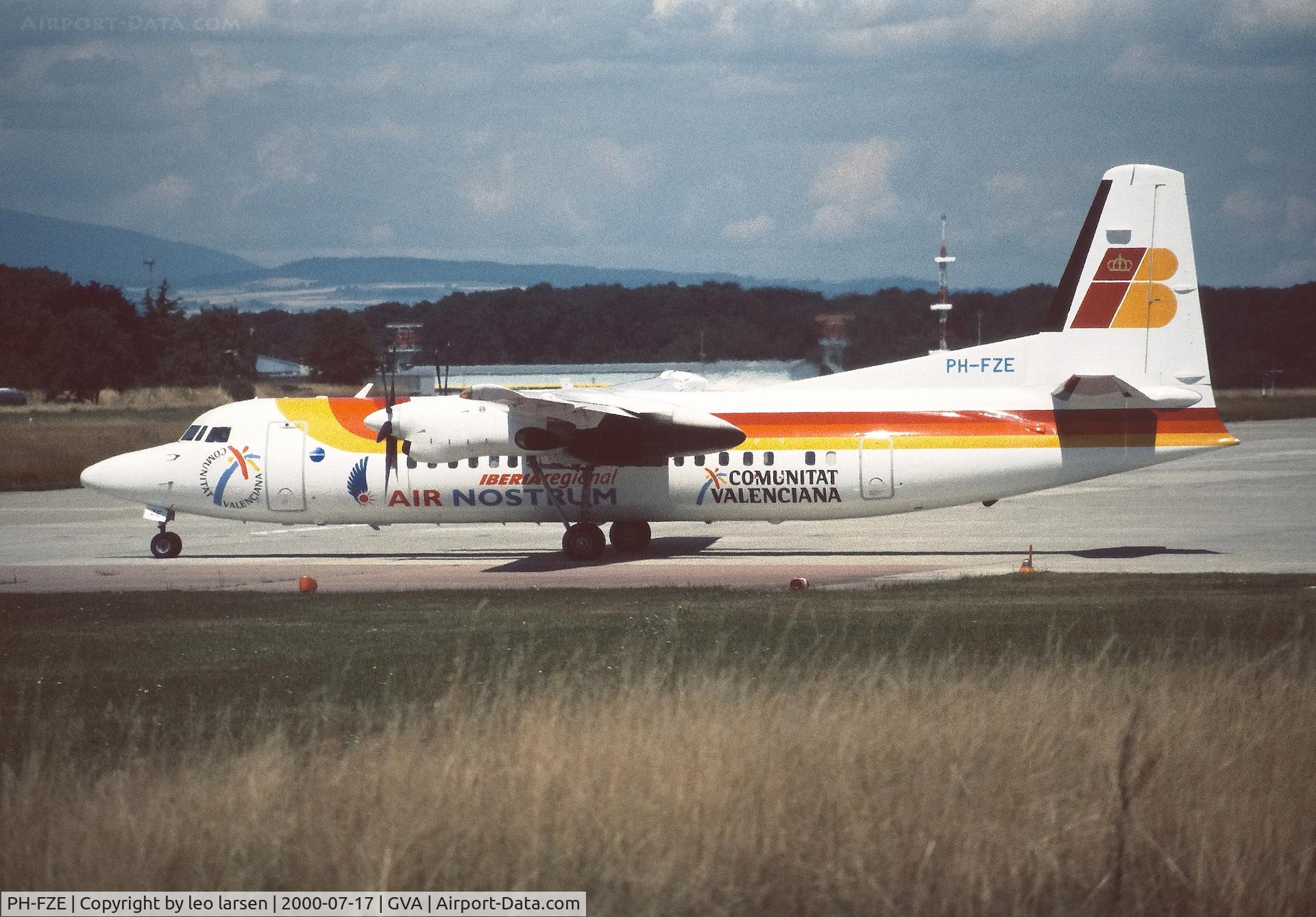
Air Nostrum
Fokker 50
After landing on runway 15 at Melilla Airport, the pilot-in-command noticed that he could not engage the ground idle/reverse of both propellers, and that the aircraft did not brake normally. The aircraft started to deviate to the left of the runway axis while both pilots were applying brakes. After tyre n°3 burst, the deviation continued until the aircraft left the paved surface of the runway and finally fell through an embankment with around 15 metres of height located at the end of runway 15. The aircraft was destroyed and the pilot-in-command and other nine people suffered minor injuries. There was no fire.