
Paris - Biarritz
Flight / Schedule
Paris - Biarritz
Aircraft
Boeing 737-200Registration
F-GBYA
MSN
23000
Year of Manufacture
1982
Operator
Air FranceDate
March 4, 1999 at 08:10 PM
Type
CRASHFlight Type
Scheduled Revenue Flight
Flight Phase
Landing (descent or approach)
Crash Site
Airport (less than 10 km from airport)
Crash Location
Biarritz Pyrénées-Atlantiques
Region
Europe • France
Coordinates
43.4717°, -1.5381°
Crash Cause
Weather
Narrative Report
On March 4, 1999 at 08:10 PM, Paris - Biarritz experienced a crash involving Boeing 737-200, operated by Air France, with the event recorded near Biarritz Pyrénées-Atlantiques.
The flight was categorized as scheduled revenue flight and the reported phase was landing (descent or approach) at a airport (less than 10 km from airport) crash site.
97 people were known to be on board, 0 fatalities were recorded, 97 survivors were identified or estimated. This corresponds to an estimated fatality rate of 0.0%.
Crew on board: 6, crew fatalities: 0, passengers on board: 91, passenger fatalities: 0, other fatalities: 0.
The listed crash cause is weather. Air France Flight 7638, a Boeing 737-228, operated on a domestic flight from Paris-Charles de Gaulle Airport to Biarritz. The co-pilot on the flight was Pilot Flying (PF). While en route, about an hour before arrival, the flight crew listened out the ATIS frequency. The latest report mentioned a visibility of 10 km, a headwind of 15 to 30 kt and rain. When descending towards Biarritz the crew obtained an avoidance heading to bypass a thunderstorm cell. The flight was subsequently cleared for an ILS DME Cat I for runway 27. In the four minutes before landing, the visibility was 1500 metres in a squall, wind 6 kt with gusts to 3 kt, its direction changing from 250° to 290°, with variations up to 330°. The Vref is 129 kt and the Vapp 149 kt. The controller cleared the flight for landing and indicated a wind of 250° at 16 kt, gusts to 30 kt and heavy rain. The first officer disconnected the autopilot and autothrottle at an altitude of approximately 1200 ft, while established on the ILS. As the aircraft descended through 1100 feet, the captain was able to see the runway ahead. On short final, the controller reported a wind of 280° at 15 to 30 kt. The aircraft gradually deviated to the left of the centre line. The captain said: "a little to the left". The aircraft then gradually returned to align with the runway centreline. The PF banked the aircraft to the left as it slightly overshot the runway centreline. The aircraft passed the threshold approximately 4 m to the right of the centreline, parallel to it, with its wings horizontal. The PF started the flare with a slight bank to the left. The thrust reduction occurred a few seconds later. The left main gear touched the runway first at an indicated airspeed of 148 kt, while the aircraft was 12 m to the left of the runway centreline. The aircraft moved 7 m to the left, rolling on the only left main gear for about two seconds. The PF used the control column and the rudder pedals to steer the airplane to the right. The right main gear touched the runway while the left wheels were about 3 m from the edge of the runway. The PF corrected the trajectory using the rudders, without using the full amplitude. The aircraft exited the runway on the left at a speed of 133 kt. The nose gear struck the concrete support of a light and broke. The right gear was damaged and the aircraft rolled approximately 400 m off the runway and came to rest near the runway, 1150 m from the threshold.
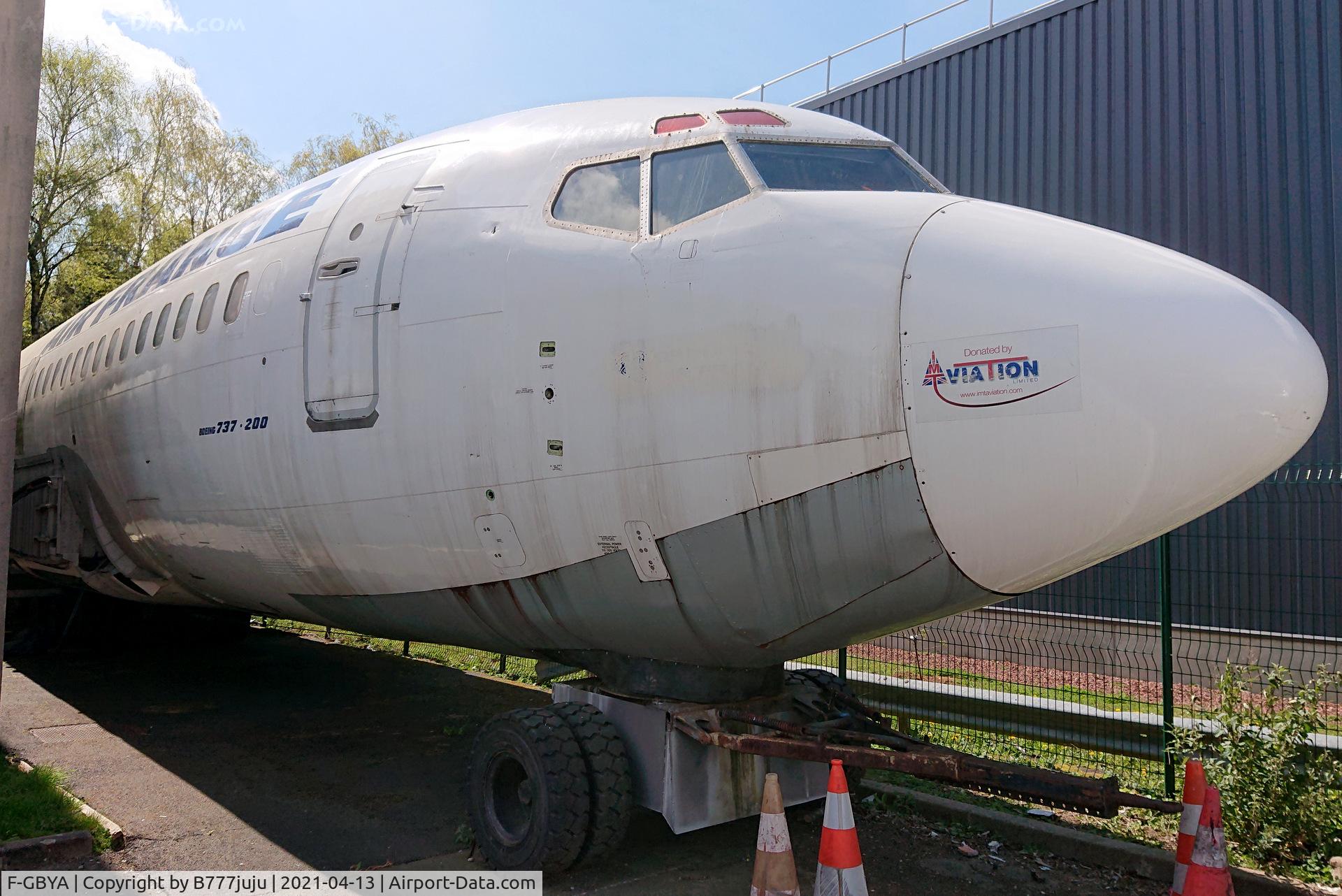
Aircraft reference details include registration F-GBYA, MSN 23000, year of manufacture 1982.
Geospatial coordinates for this crash are approximately 43.4717°, -1.5381°.
Fatalities
Total
0
Crew
0
Passengers
0
Other
0
Crash Summary
Air France Flight 7638, a Boeing 737-228, operated on a domestic flight from Paris-Charles de Gaulle Airport to Biarritz. The co-pilot on the flight was Pilot Flying (PF). While en route, about an hour before arrival, the flight crew listened out the ATIS frequency. The latest report mentioned a visibility of 10 km, a headwind of 15 to 30 kt and rain. When descending towards Biarritz the crew obtained an avoidance heading to bypass a thunderstorm cell. The flight was subsequently cleared for an ILS DME Cat I for runway 27. In the four minutes before landing, the visibility was 1500 metres in a squall, wind 6 kt with gusts to 3 kt, its direction changing from 250° to 290°, with variations up to 330°. The Vref is 129 kt and the Vapp 149 kt. The controller cleared the flight for landing and indicated a wind of 250° at 16 kt, gusts to 30 kt and heavy rain. The first officer disconnected the autopilot and autothrottle at an altitude of approximately 1200 ft, while established on the ILS. As the aircraft descended through 1100 feet, the captain was able to see the runway ahead. On short final, the controller reported a wind of 280° at 15 to 30 kt. The aircraft gradually deviated to the left of the centre line. The captain said: "a little to the left". The aircraft then gradually returned to align with the runway centreline. The PF banked the aircraft to the left as it slightly overshot the runway centreline. The aircraft passed the threshold approximately 4 m to the right of the centreline, parallel to it, with its wings horizontal. The PF started the flare with a slight bank to the left. The thrust reduction occurred a few seconds later. The left main gear touched the runway first at an indicated airspeed of 148 kt, while the aircraft was 12 m to the left of the runway centreline. The aircraft moved 7 m to the left, rolling on the only left main gear for about two seconds. The PF used the control column and the rudder pedals to steer the airplane to the right. The right main gear touched the runway while the left wheels were about 3 m from the edge of the runway. The PF corrected the trajectory using the rudders, without using the full amplitude. The aircraft exited the runway on the left at a speed of 133 kt. The nose gear struck the concrete support of a light and broke. The right gear was damaged and the aircraft rolled approximately 400 m off the runway and came to rest near the runway, 1150 m from the threshold.
Cause: Weather
Occupants & Outcome
Crew On Board
6
Passengers On Board
91
Estimated Survivors
97
Fatality Rate
0.0%
Known people on board: 97
Operational Details
Schedule / Flight
Paris - Biarritz
Operator
Air FranceFlight Type
Scheduled Revenue Flight
Flight Phase
Landing (descent or approach)
Crash Site
Airport (less than 10 km from airport)
Region / Country
Europe • France
Aircraft Details
Similar Plane Crashes
French Air Force - Armée de l'Air
Breguet 14
The aircraft crashed iupon landing somewhere in France. Pilot Charles C. Bassett survived.
Royal Air Force - RAF
De Havilland DH.4
The airplane crashed in unknown circumstances in the sea off Saint-Vaast-la-Hougue, killing both crew members. Crew: 2Lt A. H. Aitken, 2Lt D. U. Thomas.
French Air Force - Armée de l'Air
De Havilland DH.4
The DH.4 collided with a Salmson aircraft over Latrecey-Ormoy-sur-Aube and crashed, killing the pilot Raymond B. Messer.
Royal Air Force - RAF
De Havilland DH.4
The single engine aircraft departed London on a flight to Paris, carrying one pilot and one passenger, the agronomist and botanist Aaron Aaronsohn. While flying over The Channel, the aircraft crashed in unknown circumstances in the sea off Boulogne-sur-Mer. Both occupants were killed.
Vickers-Armstrongs Ltd
Vickers Viking (Serie I/II/III & IV)
The British aviator John William Alcock departed Brooklands (Weybridge) that day to Paris-Le Bourget to take part to the first airplane exhibition in Europe after the WWI. While overflying Seine-Maritime, the pilot lost control of the seaplane that crashed in Cottévrard, some 20 km north of Rouen. The pilot was seriously injured (skull fracture) and died few hours later. He performed the first nonstop transatlantic flight from Newfoundland to Ireland last 15JUN1919 with Arthur Whitten Brown. He was aged 27.
Adastral Air Lines
Avro 504
Crashed in unknown circumstances somewhere in France. While all three occupants were slightly injured, the aircraft was destroyed.