
La Romana International Airport (LRM/MDLR) → Austin-Bergstrom International Airport, TX (AUS/KAUS)
Flight / Schedule
La Romana International Airport (LRM/MDLR) → Austin-Bergstrom International Airport, TX (AUS/KAUS)
Aircraft
Gulfstream G200Registration
N318JF
MSN
093
Year of Manufacture
2004
Operator
Aibonito Aviation LLCDate
June 7, 2026 at 12:00 AM
Type
CRASHFlight Type
Ferry/positioning
Flight Phase
Landing
Crash Site
Destroyed
Crash Location
La Romana International Airport (LRM/MDLR), La Romana -
Region
Caribbean • Dominican Republic
Coordinates
18.4524°, -68.9118°
Narrative Report
On June 7, 2026 at 12:00 AM, La Romana International Airport (LRM/MDLR) → Austin-Bergstrom International Airport, TX (AUS/KAUS) experienced a crash involving Gulfstream G200, operated by Aibonito Aviation LLC, with the event recorded near La Romana International Airport (LRM/MDLR), La Romana -.
The flight was categorized as ferry/positioning and the reported phase was landing at a destroyed crash site.
2 fatalities were recorded, 0 survivors were identified or estimated.
other fatalities: 0.
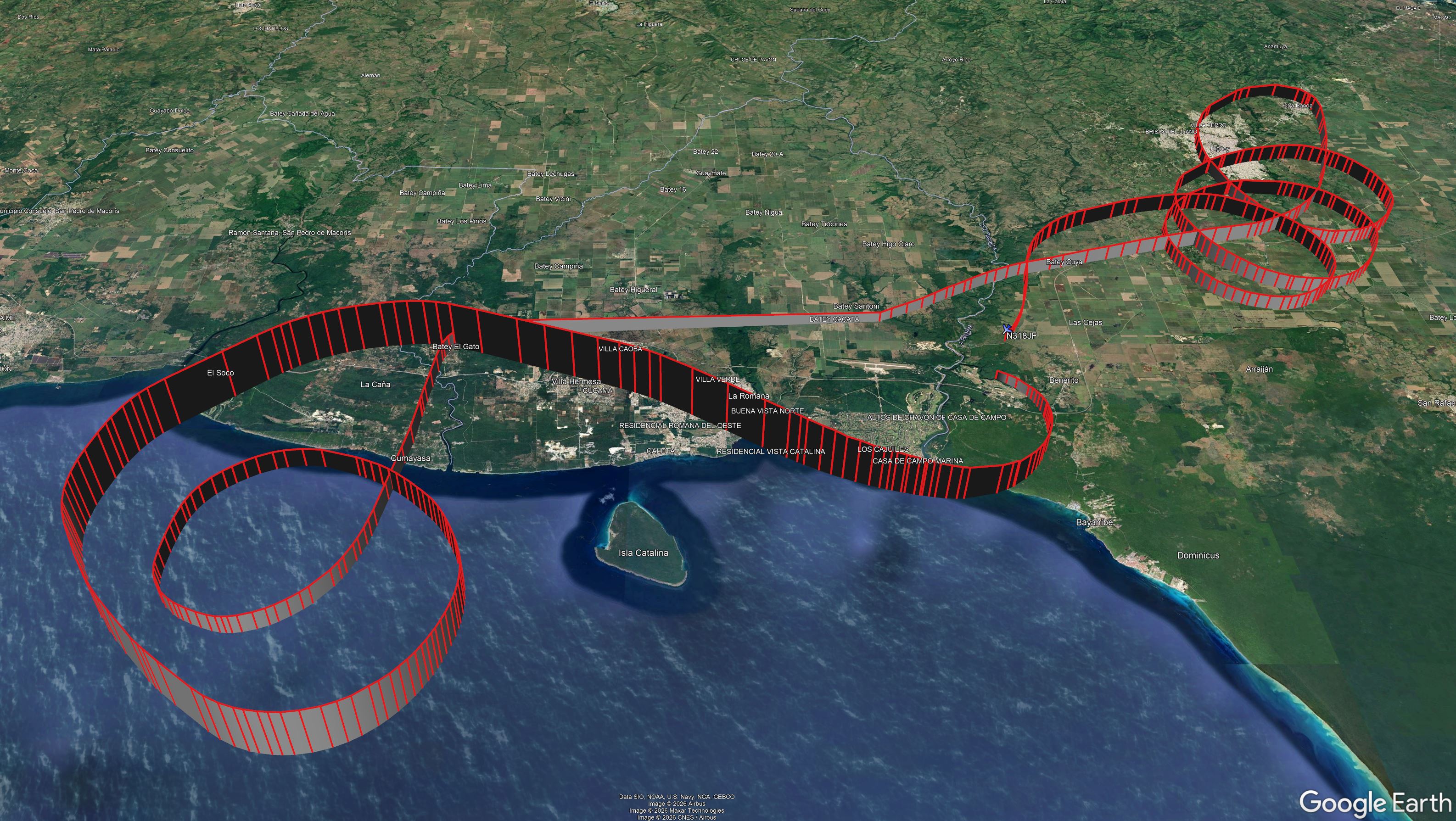
A Gulfstream G200, N318JF, was destroyed when it crashed during an attempted emergency landing on runway 29 at La Romana International Airport (LRM/MDLR), Dominican Republic. Both pilots were killed. The flight crew reported an inflight emergency (appears to be a failure of one of the engines) and their intent to return back to the airport. ADS-B data indicate that the aircraft took off from runway 11 at LRM about 19:30 UTC, making a right hand turn until it flew a 300° track. At 19:35 it began two left-hand turns and appeared to be lining up for runway 11 for an emergency landing. AD-B data is missing for about four minutes and the aircraft was then tracked circling to the north-west of the airport. After completing four left-hand turns, the aircraft lined up for an emergency landing on runway 29. Weather data at the time of landing, 20:10 UTC, indicate am 8.7 kts tailwind component. Videos of the accident sequence appear to show the aircraft veering to the left after landing. The main undercarriage collapsed as the aircraft slid across the grass next to the runway. The no.1 engine can be seen separating from the fuselage. The aircraft then burst into flames when the wing fuel tanks ruptured.
Aircraft reference details include registration N318JF, MSN 093, year of manufacture 2004.
Geospatial coordinates for this crash are approximately 18.4524°, -68.9118°.
Fatalities
Total
2
Crew
0
Passengers
0
Other
0
Crash Summary
A Gulfstream G200, N318JF, was destroyed when it crashed during an attempted emergency landing on runway 29 at La Romana International Airport (LRM/MDLR), Dominican Republic. Both pilots were killed. The flight crew reported an inflight emergency (appears to be a failure of one of the engines) and their intent to return back to the airport. ADS-B data indicate that the aircraft took off from runway 11 at LRM about 19:30 UTC, making a right hand turn until it flew a 300° track. At 19:35 it began two left-hand turns and appeared to be lining up for runway 11 for an emergency landing. AD-B data is missing for about four minutes and the aircraft was then tracked circling to the north-west of the airport. After completing four left-hand turns, the aircraft lined up for an emergency landing on runway 29. Weather data at the time of landing, 20:10 UTC, indicate am 8.7 kts tailwind component. Videos of the accident sequence appear to show the aircraft veering to the left after landing. The main undercarriage collapsed as the aircraft slid across the grass next to the runway. The no.1 engine can be seen separating from the fuselage. The aircraft then burst into flames when the wing fuel tanks ruptured.
Occupants & Outcome
Crew On Board
—
Passengers On Board
—
Estimated Survivors
0
Fatality Rate
—
Operational Details
Schedule / Flight
La Romana International Airport (LRM/MDLR) → Austin-Bergstrom International Airport, TX (AUS/KAUS)
Operator
Aibonito Aviation LLCFlight Type
Ferry/positioning
Flight Phase
Landing
Crash Site
Destroyed
Region / Country
Caribbean • Dominican Republic
Aircraft Details
Similar Plane Crashes
BWIA - British West Indies Airways
Lockheed L-414 Hudson
Crashed on takeoff for unknown reason. All nine occupants were injured and the aircraft was written off.
Dominicana de Aviación
Douglas C-47 Skytrain (DC-3)
Few minutes after its departure from Santa Cruz de Barahona Airport, the crew encountered poor weather conditions and decided to modify his route, diverting to Ciudad Trujillo, the capital city. While cruising about 20 km north of Ciudad Trujillo in low visibility, the aircraft hit the slope of a mountain and crashed near Yamasá. All 32 occupants were killed, among them members of the baseball team of Santiago returning home.
La Legión Caribe
Consolidated PBY-5A Catalina
The seaplane was used by personnel from the Legión Caribe to take part of the invasion of the Dominican Republic. As the invasion failed, the crew attempted to flee when the aircraft was shot downy by Dominican soldiers located in a speedboat. The seaplane caught fire and sank. All four crew members were killed.
VARIG - Viação Aérea Rio Grandense
Lockheed L-1049 Super Constellation
The aircraft arrived at Ciudad Trujillo on the morning of 16 August with No, 2 engine inoperative. It was decided to disembark the passengers there and continue the flight to New York via Miami, using only three engines, in order that the defective engine could be changed in New York. The aircraft, therefore, carrying only the crew, took off from General Andrews Airport, Ciudad Trujillo at 1516 hours with No. 2 propeller feathered. About 50 minutes after take-off, No. 4 engine propeller oversped and proved to be impossible to control or feather. It then tore free from the engine, damaging No. 3 engine propeller as it parted; No. 3 propeller was, therefore, feathered. In the meantime, No. 4 engine caught fire, and only No. 1 engine remained operative. As it was not possible to reach Ciudad Trujillo, an attempt was made to land on the road or the beach, but this failed owing to the large number of trees and the narrowness of the beach. Under these circumstances the aircraft was ditched parallel to the coast about 500 metres from it. It was considered that in carrying out the three-engined ferry flight without passengers, the operator acted in accordance with para. 6.2. 2, Part II of the ICAO International Standards and Recommended Practices, Annex 8 to the Convention, "when the State of Registry considers that the damage sustained is of a nature such that the aircraft is no longer airworthy, it shall prohibit the aircraft from resuming flight until it is restored to an airworthy condition; the State of Registry may, however, in exceptional circumstances, prescribe particular limiting conditions to permit the aircraft to fly without fare-paying passengers to an aerodrome at which it can be restored to an airworthy condition". After ditching, the aircraft sank to a depth of about 40 feet. On a second attempt the weather permitted a diving operation to be carried out, and inspection of the wreckage revealed the following in- formation: All six flap sections of the port wing were entirely separated from the aircraft. No. 1 engine propeller tore free at the time of impact, splitting the propeller shaft next to the propeller thrust bearing. No. 2 power plant was wrenched free from its nacelle and remained attached to it only by pipes and control cables. This propeller was feathered. The two inner flap sections of the starboard wing were fractured and partially detached from the aircraft. The No. 3 engine propeller also was feathered and the tip of one of its blades was broken a point 18 inches from the leading edge to 12 inches from the trailing edge. The trailing edge of the same blade also had two deep dents. Marks, apparently made by a propeller blade, were found on the right side of the No. 3 engine cowling, No. 4 engine propeller was missing but only a small part of the nose section of the No. 4 engine was broken. The diaphragm and the pitch reducing mechanism were in their original places. The fuselage was fractured and the crack extended diagonally across the main part from the front towards the right rear wall.
Dominicana de Aviación
Curtiss C-46 Commando
Flight 402 departed Ciudad Trujillo on a cargo flight to Miami, Florida, with a crew of 2 aboard and no passengers. Following take-off from Runway 23 and at a height of approximately 150 ft the aircraft fell to the left of the runway, some 300 ft from the centre line and 200 to 300 ft short of the runway end. Both crew members were killed by the impact which occurred at approximately 1016 hours GMT. The aircraft was destroyed by impact and fire.
Private American
Boeing B-17 Flying Fortress
During the takeoff roll at Santiago de los Caballeros-Cibao Airport, the captain decided to abandon the departure for unknown reason. Unable to stop within the remaining distance, the airplane overran and came to rest into a ditch. Both crew members were injured and the aircraft was written off. The reason that forced the crew to abandon the takeoff procedure remains unclear.