
Kaohsiung – Magong
Flight / Schedule
Kaohsiung – Magong
Aircraft
ATR72-500Registration
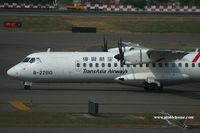
B-22810
MSN
642
Year of Manufacture
2000
Operator
TransAsia AirwaysDate
July 23, 2014 at 07:06 PM
Type
CRASHFlight Type
Scheduled Revenue Flight
Flight Phase
Landing (descent or approach)
Crash Site
City
Crash Location
Magong Penghu County (<U+6F8E><U+6E56><U+7E23>)
Region
Asia • Taiwan
Crash Cause
Human factor
Narrative Report
On July 23, 2014 at 07:06 PM, Kaohsiung – Magong experienced a crash involving ATR72-500, operated by TransAsia Airways, with the event recorded near Magong Penghu County (<U+6F8E><U+6E56><U+7E23>).
The flight was categorized as scheduled revenue flight and the reported phase was landing (descent or approach) at a city crash site.
58 people were known to be on board, 48 fatalities were recorded, 10 survivors were identified or estimated. This corresponds to an estimated fatality rate of 82.8%.
Crew on board: 4, crew fatalities: 4, passengers on board: 54, passenger fatalities: 44, other fatalities: 0.
The listed crash cause is human factor. The aircraft was being operated on an instrument flight rules (IFR) regular public transport service from Kaohsiung to Magong in the Penghu archipelago. At 1906 Taipei Local Time, the aircraft impacted terrain approximately 850 meters northeast of the threshold of runway 20 at Magong Airport and then collided with a residential area on the outskirts of Xixi village approximately 200 meters to the southeast of the initial impact zone. At the time of the occurrence, the crew was conducting a very high frequency omni-directional radio range (VOR) non-precision approach to runway 20. The aircraft was destroyed by impact forces and a post-impact fire. Ten passengers survived the occurrence and five residents on the ground sustained minor injuries. The occurrence was the result of controlled flight into terrain, that is, an airworthy aircraft under the control of the flight crew was flown unintentionally into terrain with limited awareness by the crew of the aircraft’s proximity to terrain. The crew continued the approach below the minimum descent altitude (MDA) when they were not visual with the runway environment contrary to standard operating procedures. The investigation report identified a range of contributing and other safety factors relating to the flight crew of the aircraft, TransAsia’s flight operations and safety management processes, the communication of weather information to the flight crew, coordination issues at civil/military joint-use airport, and the regulatory oversight of TransAsia by the Civil Aeronautics Administration (CAA).
Aircraft reference details include registration B-22810, MSN 642, year of manufacture 2000.
Fatalities
Total
48
Crew
4
Passengers
44
Other
0
Crash Summary
The aircraft was being operated on an instrument flight rules (IFR) regular public transport service from Kaohsiung to Magong in the Penghu archipelago. At 1906 Taipei Local Time, the aircraft impacted terrain approximately 850 meters northeast of the threshold of runway 20 at Magong Airport and then collided with a residential area on the outskirts of Xixi village approximately 200 meters to the southeast of the initial impact zone. At the time of the occurrence, the crew was conducting a very high frequency omni-directional radio range (VOR) non-precision approach to runway 20. The aircraft was destroyed by impact forces and a post-impact fire. Ten passengers survived the occurrence and five residents on the ground sustained minor injuries. The occurrence was the result of controlled flight into terrain, that is, an airworthy aircraft under the control of the flight crew was flown unintentionally into terrain with limited awareness by the crew of the aircraft’s proximity to terrain. The crew continued the approach below the minimum descent altitude (MDA) when they were not visual with the runway environment contrary to standard operating procedures. The investigation report identified a range of contributing and other safety factors relating to the flight crew of the aircraft, TransAsia’s flight operations and safety management processes, the communication of weather information to the flight crew, coordination issues at civil/military joint-use airport, and the regulatory oversight of TransAsia by the Civil Aeronautics Administration (CAA).
Cause: Human factor
Occupants & Outcome
Crew On Board
4
Passengers On Board
54
Estimated Survivors
10
Fatality Rate
82.8%
Known people on board: 58
Operational Details
Schedule / Flight
Kaohsiung – Magong
Operator
TransAsia AirwaysFlight Type
Scheduled Revenue Flight
Flight Phase
Landing (descent or approach)
Crash Site
City
Region / Country
Asia • Taiwan
Aircraft Details
Similar Plane Crashes
Dai Nippon Airlines
Junkers JU.160
Crashed on landing. Occupant fate unknown.
United States Army Air Forces - USAAF
Curtiss C-46 Commando
Crashed in unknown circumstances. Crew fate unknown as well.
United States Army Air Forces - USAAF
Curtiss C-46 Commando
Crashed on landing. No casualties.
United States Army Air Forces - USAAF
Curtiss C-46 Commando
Crashed on takeoff for unknown reason. A crew member was killed while three others were injured.
United States Army Air Forces - USAAF
Consolidated B-24 Liberator
The crew was performing a flight from Naha, Okinawa, no the airbase of Nichols, in the suburb of Manila. Enroute, while flying away from a cyclone in marginal weather conditions, the four engine aircraft christened 'Liquidator' hit the slope of a mountain located in the Seaboard Mountain Range, northeast of Taitung, Taiwan. All 25 occupants, among them PoW recently released by the Japanese troops, were killed.
Royal Air Force - RAF
Short S.25 Sunderland
The aircraft was performing a flight from Iwakuni AFB to Hong Kong on behalf of the UN Command for the Korean War. While cruising at an altitude of 5,000 feet in poor weather conditions, the Sunderland hit the slope of a mountain located near Yuli, Taiwan. The wreckage was found few days later in an isolated area and all 14 occupants have been killed.