
Harstad - Kiruna
Flight / Schedule
Harstad - Kiruna
Aircraft
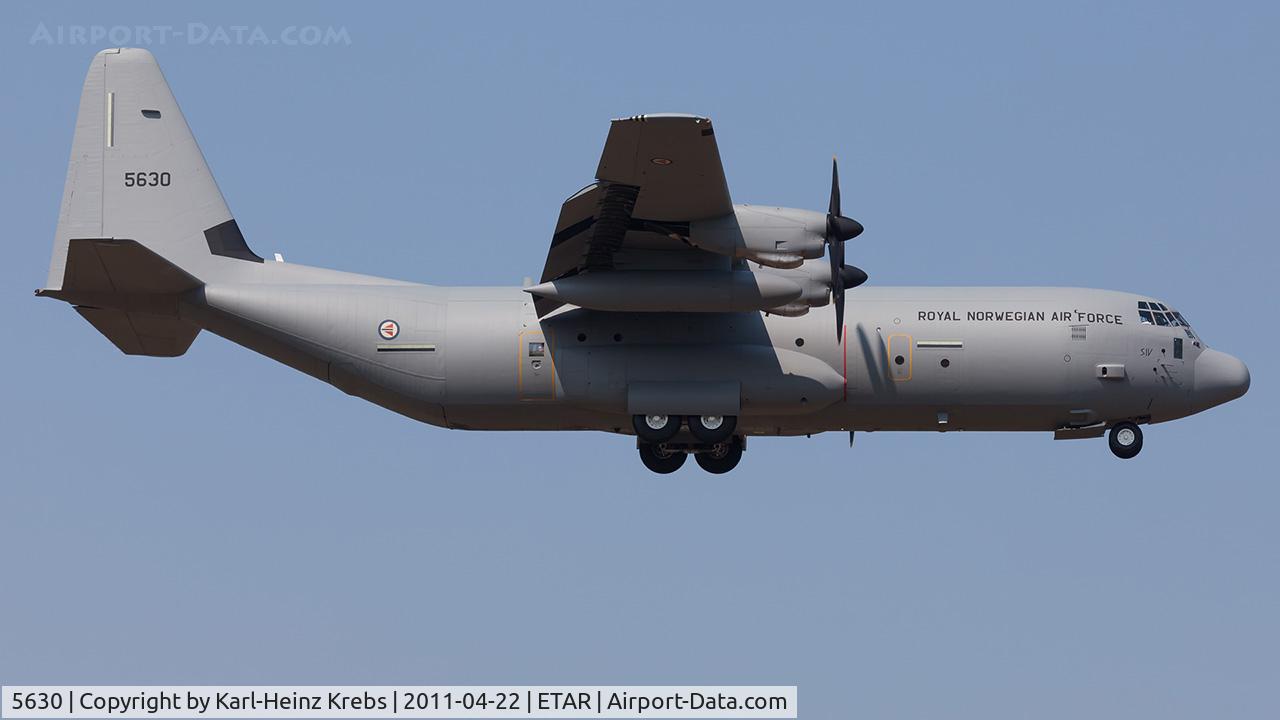
Lockheed C-130 HerculesRegistration
5630
MSN
5630
Year of Manufacture
2010
Date
March 15, 2012 at 02:57 PM
Type
CRASHFlight Type
Military
Flight Phase
Flight
Crash Site
Mountains
Crash Location
Kiruna Norrbotten
Region
Europe • Sweden
Coordinates
67.6773°, 21.6451°
Crash Cause
Human factor
Narrative Report
On March 15, 2012 at 02:57 PM, Harstad - Kiruna experienced a crash involving Lockheed C-130 Hercules, operated by Royal Norwegian Air Force - Kongelige Norske Luftforsvaret, with the event recorded near Kiruna Norrbotten.
The flight was categorized as military and the reported phase was flight at a mountains crash site.
5 people were known to be on board, 5 fatalities were recorded, 0 survivors were identified or estimated. This corresponds to an estimated fatality rate of 100.0%.
Crew on board: 4, crew fatalities: 4, passengers on board: 1, passenger fatalities: 1, other fatalities: 0.
The listed crash cause is human factor. The accident occurred during a Norwegian military transport flight from Harstad/Narvik Airport (Evenes) in Norway to Kiruna Airport in Sweden. The flight was performed as a part of the Norwegian-led military exercise Cold Response. The aircraft, which was of the model C-130J-30 Super Hercules, had the call sign HAZE 01. HAZE 01 took off with a crew of four and one passenger on board. The aircraft climbed to Flight Level 130 and assumed a holding pattern south of Evenes. After one hour, the flight continued towards Kiruna Airport. The Norwegian air traffic control had radar contact and handed over the aircraft to the air traffic control on the Swedish side. Swedish air traffic control cleared HAZE 01 to descend to Flight Level 100 “when ready” and instructed the crew to contact Kiruna Tower. The crew acknowledged the clearance and directly thereafter, the aircraft left Flight Level 130 towards Flight Level 100. The lower limit of controlled airspace at the location in question is Flight Level 125. HAZE 01 informed Kiruna Tower that the aircraft was 50 nautical miles (NM) west of Kiruna and requested a visual approach when approaching. Kiruna Tower cleared HAZE 01, which was then in uncontrolled airspace, to Flight Level 70, and the aircraft continued to descend towards the cleared flight level. Neither ACC Stockholm nor Kiruna Tower had any radar contact with the aircraft during the sequence of events because the Swedish air navigation services do not have radar coverage at the altitudes at which HAZE 01 was situated. HAZE 01 levelled out at Flight Level 70 at 14.57 hrs. Half a minute later, the aircraft collided with the terrain between the north and south peaks on the west side of Kebnekaise. Data from the aircraft's recording equipment (CVR and DFDR) showed that HAZE 01 was flying in level flight at a ground speed of approximately 280 knots prior to the moment of collision and that the crew was not aware of the imminent danger of underlying terrain. The remaining distance to Kiruna Airport was 42 NM (77 km). Everyone on board received fatal injuries. Accidents in complex systems are rarely caused by a single factor, but there are often several circumstances that must coincide for an accident to occur. The analysis of the investigation deals with the circumstances which are deemed to have influenced the sequence of events and the barriers which are intended to prevent dangerous conditions from arising. In summary, the investigation indicates that latent weaknesses have existed both at the Norwegian Air Force and at LFV. It is these weaknesses and not the mistakes of individual persons that are assessed to be the root cause of the accident. On the part of flight operations, the investigation has found shortcomings with respect to procedures for planning and following up a flight. Together with a probably high confidence in air traffic control, this has led to the crew not noticing that the clearance entailed an altitude that did not allow for adequate terrain separation. In terms of the air traffic services, the investigation demonstrates that the aircraft was not issued clearances and flight information in accordance with applicable regulations. This is due to it not having been ensured that the air traffic controllers in question had sufficient experience and knowledge to guide air traffic from the west in towards Kiruna Airport in a safe manner under the present circumstances. The lack of radar coverage reduced the opportunities for air traffic control to monitor and guide air traffic. The aircraft's Ground Collision Avoidance System is the last barrier and is intended to be activated and provide warning upon the risk of obstacles in the aircraft's flight path. The investigation has shown that with the terrain profile in question and the settings in question, the criteria for a warning were not fulfilled. No technical malfunction on the aircraft has caused or contributed to the occurrence of the accident. The rescue operation was characterized by very good access to resources from both Sweden and abroad. The operations lasted for a relatively long time and were carried out under extreme weather conditions in difficult alpine terrain. The investigation of the rescue operation demonstrates the importance of further developing management, collaboration and training in several areas.
Aircraft reference details include registration 5630, MSN 5630, year of manufacture 2010.
Geospatial coordinates for this crash are approximately 67.6773°, 21.6451°.
Fatalities
Total
5
Crew
4
Passengers
1
Other
0
Crash Summary
The accident occurred during a Norwegian military transport flight from Harstad/Narvik Airport (Evenes) in Norway to Kiruna Airport in Sweden. The flight was performed as a part of the Norwegian-led military exercise Cold Response. The aircraft, which was of the model C-130J-30 Super Hercules, had the call sign HAZE 01. HAZE 01 took off with a crew of four and one passenger on board. The aircraft climbed to Flight Level 130 and assumed a holding pattern south of Evenes. After one hour, the flight continued towards Kiruna Airport. The Norwegian air traffic control had radar contact and handed over the aircraft to the air traffic control on the Swedish side. Swedish air traffic control cleared HAZE 01 to descend to Flight Level 100 “when ready” and instructed the crew to contact Kiruna Tower. The crew acknowledged the clearance and directly thereafter, the aircraft left Flight Level 130 towards Flight Level 100. The lower limit of controlled airspace at the location in question is Flight Level 125. HAZE 01 informed Kiruna Tower that the aircraft was 50 nautical miles (NM) west of Kiruna and requested a visual approach when approaching. Kiruna Tower cleared HAZE 01, which was then in uncontrolled airspace, to Flight Level 70, and the aircraft continued to descend towards the cleared flight level. Neither ACC Stockholm nor Kiruna Tower had any radar contact with the aircraft during the sequence of events because the Swedish air navigation services do not have radar coverage at the altitudes at which HAZE 01 was situated. HAZE 01 levelled out at Flight Level 70 at 14.57 hrs. Half a minute later, the aircraft collided with the terrain between the north and south peaks on the west side of Kebnekaise. Data from the aircraft's recording equipment (CVR and DFDR) showed that HAZE 01 was flying in level flight at a ground speed of approximately 280 knots prior to the moment of collision and that the crew was not aware of the imminent danger of underlying terrain. The remaining distance to Kiruna Airport was 42 NM (77 km). Everyone on board received fatal injuries. Accidents in complex systems are rarely caused by a single factor, but there are often several circumstances that must coincide for an accident to occur. The analysis of the investigation deals with the circumstances which are deemed to have influenced the sequence of events and the barriers which are intended to prevent dangerous conditions from arising. In summary, the investigation indicates that latent weaknesses have existed both at the Norwegian Air Force and at LFV. It is these weaknesses and not the mistakes of individual persons that are assessed to be the root cause of the accident. On the part of flight operations, the investigation has found shortcomings with respect to procedures for planning and following up a flight. Together with a probably high confidence in air traffic control, this has led to the crew not noticing that the clearance entailed an altitude that did not allow for adequate terrain separation. In terms of the air traffic services, the investigation demonstrates that the aircraft was not issued clearances and flight information in accordance with applicable regulations. This is due to it not having been ensured that the air traffic controllers in question had sufficient experience and knowledge to guide air traffic from the west in towards Kiruna Airport in a safe manner under the present circumstances. The lack of radar coverage reduced the opportunities for air traffic control to monitor and guide air traffic. The aircraft's Ground Collision Avoidance System is the last barrier and is intended to be activated and provide warning upon the risk of obstacles in the aircraft's flight path. The investigation has shown that with the terrain profile in question and the settings in question, the criteria for a warning were not fulfilled. No technical malfunction on the aircraft has caused or contributed to the occurrence of the accident. The rescue operation was characterized by very good access to resources from both Sweden and abroad. The operations lasted for a relatively long time and were carried out under extreme weather conditions in difficult alpine terrain. The investigation of the rescue operation demonstrates the importance of further developing management, collaboration and training in several areas.
Cause: Human factor
Occupants & Outcome
Crew On Board
4
Passengers On Board
1
Estimated Survivors
0
Fatality Rate
100.0%
Known people on board: 5
Operational Details
Schedule / Flight
Harstad - Kiruna
Flight Type
Military
Flight Phase
Flight
Crash Site
Mountains
Region / Country
Europe • Sweden
Aircraft Details
Similar Plane Crashes
Handley Page Transport
Handley Page H.P.12
At 06.50 pm the Handley Page O/400, G-EAKE, departed for the last time from Kjeller and despite the strong winds it climbed to its cruising altitude at 2,440 metres (8,000 feet). The average speed that day was 100 kmh. Donovan explained Mrs Meisterlin under the first leg of the trip how they would fly to Karlstad and Stockholm. They crossed the Norwegian-Swedish border at 7.35 pm and Arvika at 7.55 pm. The clouds were by now getting thicker and at 8.25 pm they flew above Karlstad in 1,000 metres. They looked for Hallvard Næss and his Norman Thompson N.T.2B flying boat N-13, but in vein. He was delayed. At 9 pm they cross a landscape with thousands of tree and no possibility for an emergency landing. By now it was dark and only the fire coming from the exhaust pipe lighted up the sky. At 9.50 pm they flew above the large lake Mälaren and could enjoy a beautiful view. Donovan said, “Thumbs up – Stockholm!”, when at 11.20 pm a large city was in sight. But instead of going down, the Handley Page O/400 continued in the eastern direction and ended up above the lovely archipelago north of Stockholm. They started to fly around in circles and Donovan said, “I think they have lost themselves”. It was now decided to find as soon as possible a suitable landing site and finally the crew found a field that looked good enough. They flew in low altitude above houses and fields and finally land safely in a cornfield. Sergeant Rogers thought that the field was a regular meadow, but it turned out to be a cornfield. The aircraft suffered no damages. The following day the crew together Captain Meisterlin returned to the field where sergeant Rogers the night before had landed. The aircraft looked undamaged and therefore it was decided to start that day and proceed to Stockholm and the original landing site at Häsgerstalund. The owner of the manor gathered some local workers, who would help plough a lane through the cornfield. The lane was 5 metres wide and 300 metres long. At 3 pm the “runway” was ready and crew and passengers boarded the plane after thanking the hosts for the hospitality. Rogers switched on the engines and slowly the aircraft started on its take-off. It was however soon clear that the lane was not wide enough and that the two metres high corn touched the wings making the aircraft unstable. Sergeant Rogers tried to keep the aircraft straight, failed to do so and instead he tried to lift the aircraft from the field. By now the corn had twisted itself into the undercarriage and the aircraft crashed on its noose, tipping nearly completely around. Some were thrown out of the aircraft, while others were trapped into the fuselage. After the crash Sergeant Rogers shouted to turn off the petrol in order to avoid fire. Lieutenant Gottenborg managed to get out of the aircraft and ran to Captain Meisterlin, Donovan and Sergeant Rogers in order to free them. Donovan was the one with the worst injuries. He had burns in his face and on its hands and was in great pain. He managed to get out by himself. To get out Captain Meisterlin and Sergeant Rogers from the wreckage help was needed from the local workers. Sergeant Rogers’s leg injury (from the motor cycle accident in Norway) had worsened and he and Donovan were taken by stretcher to the ambulance and driven to the hospital in Östanå. Fortunately Dr. Nicolaysen was not hurt and could offer first aid. Mrs Meisterlin and Lieutenant Gottenborg were all unhurt and the journalist Qviller had broken his arm. Finally, the aircraft was now a total wreck and was damaged beyond repair. The flight to Stockholm and København was subsequently cancelled. Crew: Sergeant W. Rogers, pilot Mr. Donovan, mechanic. Observers: Captain Wilhelm Meisterlin and Lieutenant Brynjulf Gottenborg. Passengers: Dr. Nicolaysen, Mrs Astrid Meisterlin Mr. Haakon Qviller, journalist by the Norwegian newspaper Aftenposten. Source: Rob Mulder - www.europeanairlines.no
P.O. Flygkompani
Fairey III
While on a taxi flight, the pilot encountered control problems and attempted an emergency landing when the aircraft crash landed in a field located in Eskön, northeast of Gävle. Both occupants escaped uninjured and the aircraft was damaged beyond repair.
Swedish Air Force - Flygvapnet
FVM S.18
The aircraft crashed in unknown circumstances, killing both occupants.
Tryggve Gran
Armstrong Whitworth F.K.8
En route from Stockholm to Kristiania, the engine caught fire. The crew made an emergency landing in an open field located in Örebro and extinguished the fire. Shortly after takeoff, the aircraft went out of control and crashed upside down. Both occupants, Major Tryggve Gran and Captain Larry Carter, were uninjured and the aircraft was destroyed.
Swedish Air Force - Flygvapnet
FVM S.18
The crew was conducting a local training flight at Malmen AFB. While circling in the vicinity of the airbase, the aircraft collided with a Swedish Air Force Phönix C.1 Dront Ö4 registered 116. While the crew of the Phönix was able to make an emergency landing and was uninjured, the FVM S.18 entered a dive and crashed, killing its both occupants.
Swedish Navy - Svenska Marinen
Savoia S.13
Crashed in unknown circumstances in the sea off Märsgarn Island. The pilot, sole on board, was rescued.