
San Juan - Charlotte Amalie
Flight / Schedule
San Juan - Charlotte Amalie
Aircraft
Douglas DC-3Registration
N136FS
MSN
10267
Year of Manufacture
1943
Operator
Four Star Air CargoDate
April 26, 2009 at 04:28 AM
Type
CRASHFlight Type
Cargo
Flight Phase
Taxiing
Crash Site
Airport (less than 10 km from airport)
Crash Location
San Juan-Luis Muñoz Marín (Isla Verde) All Puerto Rico
Region
Central America • Puerto Rico
Crash Cause
Technical failure
Narrative Report
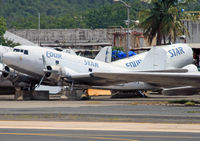
On April 26, 2009 at 04:28 AM, San Juan - Charlotte Amalie experienced a crash involving Douglas DC-3, operated by Four Star Air Cargo, with the event recorded near San Juan-Luis Muñoz Marín (Isla Verde) All Puerto Rico.
The flight was categorized as cargo and the reported phase was taxiing at a airport (less than 10 km from airport) crash site.
4 people were known to be on board, 0 fatalities were recorded, 4 survivors were identified or estimated. This corresponds to an estimated fatality rate of 0.0%.
Crew on board: 2, crew fatalities: 0, passengers on board: 2, passenger fatalities: 0, other fatalities: 0.
The listed crash cause is technical failure. During taxi to a runway, the instrument panel and cockpit floor erupted in flames. Examination of the wreckage revealed that the majority of the wires contained inside the main junction box had very little damage except for two wires that had insulation missing. The damage appeared to be associated with the routing of the two wires. Both wires were connected to the battery relay and ran through wires in and around the exposed terminal studs. Heat damage was noted on the insulation of wires and other components that were in contact with the exposed wires. The wires ran from the battery relay to the forward section of the cockpit, where the fire started. Due to the fire damage that consumed the cockpit, the examination was unable to determine what system the wires were associated with. Further examination revealed that the fuel pressure was a direct indicating system. Fuel traveled directly to the instruments in the cockpit via rigid aluminum lines routed on the right lower side of the fuselage, where more severe fire damage was noted. Review of maintenance records did not reveal any evidence of the fuel pressure indicating system lines and hoses having ever been replaced; however, they were only required to be replaced on an as-needed basis. The electrical system, instrument lines, and hoses through the nose compartment were required to be inspected on a Phase D inspection; the airplane's last Phase D inspection was completed about 9 months prior to the accident and the airplane had accrued 313.1 hours of operation since that inspection.
Aircraft reference details include registration N136FS, MSN 10267, year of manufacture 1943.
Fatalities
Total
0
Crew
0
Passengers
0
Other
0
Crash Summary
During taxi to a runway, the instrument panel and cockpit floor erupted in flames. Examination of the wreckage revealed that the majority of the wires contained inside the main junction box had very little damage except for two wires that had insulation missing. The damage appeared to be associated with the routing of the two wires. Both wires were connected to the battery relay and ran through wires in and around the exposed terminal studs. Heat damage was noted on the insulation of wires and other components that were in contact with the exposed wires. The wires ran from the battery relay to the forward section of the cockpit, where the fire started. Due to the fire damage that consumed the cockpit, the examination was unable to determine what system the wires were associated with. Further examination revealed that the fuel pressure was a direct indicating system. Fuel traveled directly to the instruments in the cockpit via rigid aluminum lines routed on the right lower side of the fuselage, where more severe fire damage was noted. Review of maintenance records did not reveal any evidence of the fuel pressure indicating system lines and hoses having ever been replaced; however, they were only required to be replaced on an as-needed basis. The electrical system, instrument lines, and hoses through the nose compartment were required to be inspected on a Phase D inspection; the airplane's last Phase D inspection was completed about 9 months prior to the accident and the airplane had accrued 313.1 hours of operation since that inspection.
Cause: Technical failure
Occupants & Outcome
Crew On Board
2
Passengers On Board
2
Estimated Survivors
4
Fatality Rate
0.0%
Known people on board: 4
Operational Details
Schedule / Flight
San Juan - Charlotte Amalie
Operator
Four Star Air CargoFlight Type
Cargo
Flight Phase
Taxiing
Crash Site
Airport (less than 10 km from airport)
Region / Country
Central America • Puerto Rico
Aircraft Details
Similar Plane Crashes
Pan American World Airways - PAA
Loening C-W Air Yacht
While taking off from the bay in Puerto Rico, the seaplane hit an embankment and came to rest. Both crew members were rescued and the aircraft sank.
Pan American World Airways - PAA
Sikorsky S-38
Upon landing off San Juan, the floatplane collided with an undetermined floating object and was damaged beyond repair. All nine occupants were rescued.
United Airlines
Douglas DC-3
On final approach, the aircraft lost 400 feet in few seconds and eventually crashed into the bay of San Francisco, some two miles off the airport. All eleven occupants were killed. Crew: A. R. Thompson, pilot, Joe Decesaro, copilot, Ruth Kimmel, stewardess.
KLM Royal Dutch Airlines - Koninklijke Luchtvaart Maatschappij
Douglas DC-3
The aircraft was on a delivery flight to the Dutch National Company based in Amsterdam and should be flown from Long Beach to New York with intermediate stops in Phoenix and Kansas City. While proceeding in poor weather conditions, aircraft hit Baldy Peak located some 250 km northeast of Phoenix. All eight occupants were killed.
KLM Royal Dutch Airlines - Koninklijke Luchtvaart Maatschappij
Douglas DC-3
Shortly after takeoff from Palembang-Talang Airport, while in initial climb, the left engine failed. Crew decided to return for a safe landing but the aircraft hit tree tops, stalled and crashed near the airport. The cockpit was destroyed and separated from the rest of the aircraft, killing three crew. A passenger was killed as well. The aircraft was christened 'Specht'. Crew: F.M. Stork, pilot, † H.J. Groeneveld, copilot, J. J. Ruben, engineer, † J. J. Stodieck, radio. †
United Airlines
Douglas DC-3
While cruising at 10,000 feet at night and in bad weather conditions, pilot tried to contact ATC without any success. He could not receive any signal from the regional beacon and decided to continue ahead to Salt Lake City Airport. Few minutes later, in low visibility, the aircraft hit the Haydens Peak at a height of 10,000 feet and located 81 km east from Salt Lake City and 32 km southwest from Knight. All 19 occupants were killed. Up to date, worst plane crash in the US. Crew: Earl D. Woodgerd, pilot, John B. Adams, copilot, Leah Derr, stewardess.