
Fort Lauderdale – Marsh Harbour
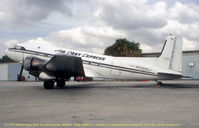
Flight / Schedule
Fort Lauderdale – Marsh Harbour
Aircraft
Douglas DC-3Registration
N3906J
MSN
43344
Year of Manufacture
1943
Operator
Air Pony ExpressDate
June 13, 2005 at 03:50 PM
Type
CRASHFlight Type
Cargo
Flight Phase
Takeoff (climb)
Crash Site
City
Crash Location
Fort Lauderdale-Executive Florida
Region
North America • United States of America
Coordinates
26.1960°, -80.1808°
Crash Cause
Human factor
Narrative Report
On June 13, 2005 at 03:50 PM, Fort Lauderdale – Marsh Harbour experienced a crash involving Douglas DC-3, operated by Air Pony Express, with the event recorded near Fort Lauderdale-Executive Florida.
The flight was categorized as cargo and the reported phase was takeoff (climb) at a city crash site.
3 people were known to be on board, 0 fatalities were recorded, 3 survivors were identified or estimated. This corresponds to an estimated fatality rate of 0.0%.
Crew on board: 2, crew fatalities: 0, passengers on board: 1, passenger fatalities: 0, other fatalities: 0.
The listed crash cause is human factor. The crew stated the airplane was hire by a private individual and had 220 gallons of fuel onboard, and was carrying 6 pieces of granite, weighing 3,200 lbs. The passenger was responsible for the granite during the flight. During takeoff, about 400 feet above the ground, a discrepancy with the left engine manifold pressure was noted, followed by a slight hesitation and mild backfire. Oil was seen leaking from the front nose section of the engine followed by an engine manifold pressure and rpm decrease. Smoke coming from the left engine was observed and reported by the airport controllers. The left engine's propeller failed to feather and the airplane wouldn't maintain altitude. The airplane impacted trees, vehicles, and the right wing struck a home before coming to a stop on the road. A fire ensued immediately after ground impact, all onboard exited without assistance. The fuselage from the cockpit to the tail section melted from the fire. The right wing was damaged by impact and fire, and the right engine remained intact on the wing. The left wing was separated 12 feet from the outboard and the engine separated from the firewall. Both engine's propellers were in the low pitch position. The flaps were full up and the landing gear were retracted. A weight and balance sheet was never furnished. The pieces of granite and limited cargo recovered from the wreckage weighed 3,140 lb. Examination of the airplane revealed all flight controls surface were present and flight control continuity was accounted for and established. No evidence of any pre-impact mechanical discrepancies with the airframe or its systems was found that wound have prevented normal operation of airplane. On December 09, 2004, the left engine's nose section assembly was found with six out of the ten retaining bolts broken. The section was inspected and all ten bolts were replaced with serviceable ones. The assembly of the dose dome section and installation to the engine was performed by the repair station mechanic. The remaining assembling of the engine was completed by the operator's mechanic/pilot. During the left engine post accident examination, the ten bolts securing the nose dome section flange to the stationary reduction gear were fractured with their respective safety wire still intact. The chamber for the propeller feathering oil system was not secured to the plate sections, producing a bypass of the oil for the propeller feathering process. Metal flakes and pieces were observed deposited in the oil breather screen, consistent with the master rod bearing in an advance stage of deterioration. The silver plated master rod bearing had a catastrophic failure. Silver like metal flakes and particles were observed throughout the nose section, reduction gear section, main oil screen, and oil filter housing of the engine. An indication of propeller shaft housing movement was evident. Metal flakes with carbon build up were observed in the propeller shaft support and sleeve assembly. A metallurgical examination of the ten bolts securing the nose dome assembly indicated all were fractured though the threaded section of the shanks. The fatigue zones propagated from the opposite sides toward the center of the bolts consistent with reversed bending of the bolt.
Aircraft reference details include registration N3906J, MSN 43344, year of manufacture 1943.
Geospatial coordinates for this crash are approximately 26.1960°, -80.1808°.
Fatalities
Total
0
Crew
0
Passengers
0
Other
0
Crash Summary
The crew stated the airplane was hire by a private individual and had 220 gallons of fuel onboard, and was carrying 6 pieces of granite, weighing 3,200 lbs. The passenger was responsible for the granite during the flight. During takeoff, about 400 feet above the ground, a discrepancy with the left engine manifold pressure was noted, followed by a slight hesitation and mild backfire. Oil was seen leaking from the front nose section of the engine followed by an engine manifold pressure and rpm decrease. Smoke coming from the left engine was observed and reported by the airport controllers. The left engine's propeller failed to feather and the airplane wouldn't maintain altitude. The airplane impacted trees, vehicles, and the right wing struck a home before coming to a stop on the road. A fire ensued immediately after ground impact, all onboard exited without assistance. The fuselage from the cockpit to the tail section melted from the fire. The right wing was damaged by impact and fire, and the right engine remained intact on the wing. The left wing was separated 12 feet from the outboard and the engine separated from the firewall. Both engine's propellers were in the low pitch position. The flaps were full up and the landing gear were retracted. A weight and balance sheet was never furnished. The pieces of granite and limited cargo recovered from the wreckage weighed 3,140 lb. Examination of the airplane revealed all flight controls surface were present and flight control continuity was accounted for and established. No evidence of any pre-impact mechanical discrepancies with the airframe or its systems was found that wound have prevented normal operation of airplane. On December 09, 2004, the left engine's nose section assembly was found with six out of the ten retaining bolts broken. The section was inspected and all ten bolts were replaced with serviceable ones. The assembly of the dose dome section and installation to the engine was performed by the repair station mechanic. The remaining assembling of the engine was completed by the operator's mechanic/pilot. During the left engine post accident examination, the ten bolts securing the nose dome section flange to the stationary reduction gear were fractured with their respective safety wire still intact. The chamber for the propeller feathering oil system was not secured to the plate sections, producing a bypass of the oil for the propeller feathering process. Metal flakes and pieces were observed deposited in the oil breather screen, consistent with the master rod bearing in an advance stage of deterioration. The silver plated master rod bearing had a catastrophic failure. Silver like metal flakes and particles were observed throughout the nose section, reduction gear section, main oil screen, and oil filter housing of the engine. An indication of propeller shaft housing movement was evident. Metal flakes with carbon build up were observed in the propeller shaft support and sleeve assembly. A metallurgical examination of the ten bolts securing the nose dome assembly indicated all were fractured though the threaded section of the shanks. The fatigue zones propagated from the opposite sides toward the center of the bolts consistent with reversed bending of the bolt.
Cause: Human factor
Occupants & Outcome
Crew On Board
2
Passengers On Board
1
Estimated Survivors
3
Fatality Rate
0.0%
Known people on board: 3
Operational Details
Schedule / Flight
Fort Lauderdale – Marsh Harbour
Operator
Air Pony ExpressFlight Type
Cargo
Flight Phase
Takeoff (climb)
Crash Site
City
Region / Country
North America • United States of America
Aircraft Details
Similar Plane Crashes
United States Signal Corps - USSC
De Havilland DH.4
The single engine airplane departed Dayton-McCook Field for a local test flight. Shortly after takeoff, the aircraft stalled and crashed, killing both occupants. Crew: Maj Oscar Brindley, Lt Col Henry Damm.
United States Signal Corps - USSC
De Havilland DH.4
Lt. Frank Stuart Patterson, son and nephew of the co-founders of National Cash Register, is killed in the crash of his DH.4M, AS-32098, at Wilbur Wright Field during a flight test of a new mechanism for synchronizing machine gun and propeller, when a tie rod breaks during a dive from 15,000 feet (4,600 m), causing the wings to separate from the aircraft. Wishing to recognize the contributions of the Patterson family (owners of NCR) the area of Wright Field east of Huffman Dam (including Wilbur Wright Field, Fairfield Air Depot, and the Huffman Prairie) is renamed Patterson Field on 6 July 1931, in honor of Lt. Patterson.
United States Signal Corps - USSC
De Havilland DH.4
The aircraft crashed in unknown circumstances.
United States Signal Corps - USSC
De Havilland DH.4
The crew was completing a training mission. At an altitude of about 4,000 feet, the aircraft entered a spin and crashed in an open field near Everman-Barron Field Airport. A crew was killed and the second occupants was injured. The aircraft was destroyed.
U.S. Air Mail Service
De Havilland DH.4
Crashed following an engine failure. Pilot fate unknown.
United States Signal Corps - USSC
De Havilland DH.4
The accident occurred in unknown circumstances.