
Dublin - Sligo
Flight / Schedule
Dublin - Sligo
Aircraft
Fokker F27 FriendshipRegistration
G-ECAT
MSN
10672
Year of Manufacture
1984
Operator
Euroceltic AirwaysDate
November 2, 2002 at 05:02 PM
Type
CRASHFlight Type
Scheduled Revenue Flight
Flight Phase
Landing (descent or approach)
Crash Site
Airport (less than 10 km from airport)
Crash Location
Sligo Connacht
Region
Europe • Ireland
Coordinates
54.2534°, -8.4931°
Crash Cause
Human factor
Narrative Report
On November 2, 2002 at 05:02 PM, Dublin - Sligo experienced a crash involving Fokker F27 Friendship, operated by Euroceltic Airways, with the event recorded near Sligo Connacht.
The flight was categorized as scheduled revenue flight and the reported phase was landing (descent or approach) at a airport (less than 10 km from airport) crash site.
40 people were known to be on board, 0 fatalities were recorded, 40 survivors were identified or estimated. This corresponds to an estimated fatality rate of 0.0%.
Crew on board: 4, crew fatalities: 0, passengers on board: 36, passenger fatalities: 0, other fatalities: 0.
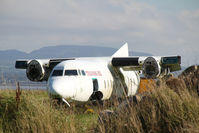
The listed crash cause is human factor. The aircraft, a Fokker F27-500, registration G-ECAT, departed Dublin at 16.05 hrs (local time) for the 4th leg of a Public Service Obligation (PSO) rotation between Sligo in the North West of Ireland and Dublin. The aircraft had earlier departed Sligo for Dublin at 10.00 hrs, returned to Sligo at 12.30 hrs and departed once again for Dublin on time at 14.30 hrs. The Operator held the PSO contract to provide regular air service between Sligo and Dublin and also between Donegal (EIDL) and Dublin. The accident flight was delayed for 10 minutes as the flight to Donegal had been cancelled due to strong crosswinds at Donegal and arrangements had been made to fly these passengers to Sligo and bus them onwards to Donegal. The en-route segment of this flight was uneventful. At 16.22 hrs G-ECAT called Sligo on Tower frequency 122.10 Mhz and requested the latest weather conditions for Sligo. The Tower Controller transmitted the 16.30 hrs actual for Sligo, as presented at Section 1.7 Meteorological Information. At 16.50 hrs, the aircraft was handed over from Shannon Control to Sligo Tower, descending to 3,500 ft to the SLG beacon for NDB/DME approach to RWY 11. Sligo Tower then transmitted the Donegal weather, as presented at Section 1.7 Meteorological Information. At 16.53 hrs, the aircraft called overhead the SLG beacon and was cleared by Sligo Tower for the approach. At 17.00 hrs, G-ECAT reported at the Final Approach Fix (FAF) and was cleared to land by the Tower, giving a wind of 120 degrees 15 kt, gusting 29 kt. At 17.01 hrs, just prior to landing, G-ECAT was given a wind check of 120 degrees 15 kt, gusting 31 kt. At 17.02 hrs the aircraft made an initial touchdown at approximately the mid-point of the runway and appeared to a number of witnesses not to immediately decelerate. The aircraft continued down the runway until it departed the paved surface at the right hand side of the threshold of RWY 29. On seeing the aircraft pass the apron taxiway/runway intersection at an abnormally high speed, the Tower Controller immediately sounded the crash alarm. The aircraft continued on through a prepared run-off area at the end of the runway, for a further 50 metres, before coming to rest (17.02:30 hrs) with the main wheels embedded in boulders that formed part of an embankment leading down to the sea. The main wheels were approximately one metre short of where the boulders fall away into the sea. The nose wheel, cockpit and forward section of the fuselage cleared the top of the boulder embankment and the aircraft tilted approximately 15-20 degrees nose down onto the outgoing tide. Full tide was due at 04.00 hrs the following day at a depth of 3.9 meters. The Tower Controller immediately contacted the Shannon ATC Station Manager advising of the runway excursion and called 999 to request Gardaí, Fire Brigade and Ambulance assistance.
Aircraft reference details include registration G-ECAT, MSN 10672, year of manufacture 1984.
Geospatial coordinates for this crash are approximately 54.2534°, -8.4931°.
Fatalities
Total
0
Crew
0
Passengers
0
Other
0
Crash Summary
The aircraft, a Fokker F27-500, registration G-ECAT, departed Dublin at 16.05 hrs (local time) for the 4th leg of a Public Service Obligation (PSO) rotation between Sligo in the North West of Ireland and Dublin. The aircraft had earlier departed Sligo for Dublin at 10.00 hrs, returned to Sligo at 12.30 hrs and departed once again for Dublin on time at 14.30 hrs. The Operator held the PSO contract to provide regular air service between Sligo and Dublin and also between Donegal (EIDL) and Dublin. The accident flight was delayed for 10 minutes as the flight to Donegal had been cancelled due to strong crosswinds at Donegal and arrangements had been made to fly these passengers to Sligo and bus them onwards to Donegal. The en-route segment of this flight was uneventful. At 16.22 hrs G-ECAT called Sligo on Tower frequency 122.10 Mhz and requested the latest weather conditions for Sligo. The Tower Controller transmitted the 16.30 hrs actual for Sligo, as presented at Section 1.7 Meteorological Information. At 16.50 hrs, the aircraft was handed over from Shannon Control to Sligo Tower, descending to 3,500 ft to the SLG beacon for NDB/DME approach to RWY 11. Sligo Tower then transmitted the Donegal weather, as presented at Section 1.7 Meteorological Information. At 16.53 hrs, the aircraft called overhead the SLG beacon and was cleared by Sligo Tower for the approach. At 17.00 hrs, G-ECAT reported at the Final Approach Fix (FAF) and was cleared to land by the Tower, giving a wind of 120 degrees 15 kt, gusting 29 kt. At 17.01 hrs, just prior to landing, G-ECAT was given a wind check of 120 degrees 15 kt, gusting 31 kt. At 17.02 hrs the aircraft made an initial touchdown at approximately the mid-point of the runway and appeared to a number of witnesses not to immediately decelerate. The aircraft continued down the runway until it departed the paved surface at the right hand side of the threshold of RWY 29. On seeing the aircraft pass the apron taxiway/runway intersection at an abnormally high speed, the Tower Controller immediately sounded the crash alarm. The aircraft continued on through a prepared run-off area at the end of the runway, for a further 50 metres, before coming to rest (17.02:30 hrs) with the main wheels embedded in boulders that formed part of an embankment leading down to the sea. The main wheels were approximately one metre short of where the boulders fall away into the sea. The nose wheel, cockpit and forward section of the fuselage cleared the top of the boulder embankment and the aircraft tilted approximately 15-20 degrees nose down onto the outgoing tide. Full tide was due at 04.00 hrs the following day at a depth of 3.9 meters. The Tower Controller immediately contacted the Shannon ATC Station Manager advising of the runway excursion and called 999 to request Gardaí, Fire Brigade and Ambulance assistance.
Cause: Human factor
Occupants & Outcome
Crew On Board
4
Passengers On Board
36
Estimated Survivors
40
Fatality Rate
0.0%
Known people on board: 40
Operational Details
Schedule / Flight
Dublin - Sligo
Operator
Euroceltic AirwaysFlight Type
Scheduled Revenue Flight
Flight Phase
Landing (descent or approach)
Crash Site
Airport (less than 10 km from airport)
Region / Country
Europe • Ireland
Aircraft Details
Similar Plane Crashes
Vickers-Armstrongs Ltd
Vickers FB.27 Vimy Commercial
British aviators John Alcock and Arthur Whitten Brown were performing one of the first transatlantic crossflight from the US to Europe. The aircraft departed Saint John’s-Lester Field, Newfoundland, on 14JUN1919 at 1345LT. Following an uneventful flight of 15 hours and 57 minutes at an altitude of 12,000 feet and at an average speed of 185 km/h, both pilots reached the Irish coast on the morning of June 15. While landing in an open field located in Clifden, Galway, the twin engine aircraft nosed down and came to rest. Both pilots were slightly injured while the aircraft was damaged beyond repair.
Irish Air Corps - Aer Chór na hÉireann
De Havilland DH.9
The crew was completing a local training flight at Fermoy Aerodrome. The accident occurred in unknown circumstances. While the pilot was seriously injured, the observer was killed. Crew: Lt McCullogh, pilot, Lt John Francis McDonagh, observer. †
Irish Air Corps - Aer Chór na hÉireann
De Havilland DH.60 Moth
Shortly after takeoff, while climbing, the aircraft went out of control and crashed, killing the pilot, sole on board.
Irish Air Corps - Aer Chór na hÉireann
De Havilland DH.60 Moth
The crew was engaged in a local training mission at Baldonnel-Casement AFB. On final approach, the aircraft crashed in unknown circumstances, injuring both pilots.
Iona National Airways
De Havilland DH.60 Moth
The single engine airplane departed Kildonan Aerodrome in Finglas with one passenger and one pilot on board. In unknown circumstances, the aircraft crashed on the roof of a farm located in Bundoran, Ulster. Both occupants were injured and the aircraft was destroyed. Crew: L. S. Coogan, pilot. Passenger: J. Doherty.
Macfadden Publications
Lockheed 8 Sirius/Altair
The pilot Lou Reichers departed Harbour Grace on a new record solo flight to Paris. While cruising over Ireland, he encountered an unexpected situation and was forced to ditch the airplane in the Bandon River off Kinsale, south Ireland. He was rescued by the crew of 'USS President Roosevelt' while the airplane sank and was lost.