
Beaumont – Springdale
Flight / Schedule
Beaumont – Springdale
Aircraft
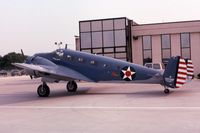
Beechcraft C18SRegistration
N9729H
MSN
8205
Year of Manufacture
1945
Operator
Robert A. YounkinDate
May 23, 1999 at 07:15 PM
Type
CRASHFlight Type
Executive/Corporate/Business
Flight Phase
Landing (descent or approach)
Crash Site
Airport (less than 10 km from airport)
Crash Location
Waldron Arkansas
Region
North America • United States of America
Coordinates
34.8984°, -94.0908°
Crash Cause
Technical failure
Narrative Report
On May 23, 1999 at 07:15 PM, Beaumont – Springdale experienced a crash involving Beechcraft C18S, operated by Robert A. Younkin, with the event recorded near Waldron Arkansas.
The flight was categorized as executive/corporate/business and the reported phase was landing (descent or approach) at a airport (less than 10 km from airport) crash site.
1 people were known to be on board, 1 fatalities were recorded, 0 survivors were identified or estimated. This corresponds to an estimated fatality rate of 100.0%.
Crew on board: 1, crew fatalities: 1, passengers on board: 0, passenger fatalities: 0, other fatalities: 0.
The listed crash cause is technical failure. During a cross-country flight, the pilot of the twin-engine airplane reported to air traffic control that he has 'lost an engine.' A witness observed the right engine hanging from its lower mounts as the airplane turned right and headed towards the nearest airport. The airplane impacted trees approximately 1 mile short of the runway threshold. Examination of the right engine propeller revealed that one of its blades was separated about mid-span. The separated tip section of the blade was not recovered. Metallurgical examination of the fracture surface revealed that the blade failed as a result of a fatigue crack that originated from corrosion pits on the camber surface (face) of the blade. The failed blade was examined approximately 6 hours prior to the accident in accordance with an airworthiness directive (AD 81-13-06 R2) that called for inspections of the blade for corrosion and fatigue. However, the inspections called out in the AD were only applicable to the blade fillet and shank regions, well inboard of the fracture location on the failed blade. Overhaul of the propeller in accordance with the propeller manufacturer's manual includes grinding of each blade to 'remove all visual evidence of corrosion.' According to the airplane's owner, the propellers had not been overhauled in the eight years that he had owned the aircraft. The maintenance records were destroyed in the accident, which precluded determination of the date and time of the last propeller overhaul. The accident airplane was being operated under Title 14 CFR Part 91, and therefore, the propellers were not required to be overhauled at specified intervals.
Aircraft reference details include registration N9729H, MSN 8205, year of manufacture 1945.
Geospatial coordinates for this crash are approximately 34.8984°, -94.0908°.
Fatalities
Total
1
Crew
1
Passengers
0
Other
0
Crash Summary
During a cross-country flight, the pilot of the twin-engine airplane reported to air traffic control that he has 'lost an engine.' A witness observed the right engine hanging from its lower mounts as the airplane turned right and headed towards the nearest airport. The airplane impacted trees approximately 1 mile short of the runway threshold. Examination of the right engine propeller revealed that one of its blades was separated about mid-span. The separated tip section of the blade was not recovered. Metallurgical examination of the fracture surface revealed that the blade failed as a result of a fatigue crack that originated from corrosion pits on the camber surface (face) of the blade. The failed blade was examined approximately 6 hours prior to the accident in accordance with an airworthiness directive (AD 81-13-06 R2) that called for inspections of the blade for corrosion and fatigue. However, the inspections called out in the AD were only applicable to the blade fillet and shank regions, well inboard of the fracture location on the failed blade. Overhaul of the propeller in accordance with the propeller manufacturer's manual includes grinding of each blade to 'remove all visual evidence of corrosion.' According to the airplane's owner, the propellers had not been overhauled in the eight years that he had owned the aircraft. The maintenance records were destroyed in the accident, which precluded determination of the date and time of the last propeller overhaul. The accident airplane was being operated under Title 14 CFR Part 91, and therefore, the propellers were not required to be overhauled at specified intervals.
Cause: Technical failure
Occupants & Outcome
Crew On Board
1
Passengers On Board
0
Estimated Survivors
0
Fatality Rate
100.0%
Known people on board: 1
Operational Details
Schedule / Flight
Beaumont – Springdale
Operator
Robert A. YounkinFlight Type
Executive/Corporate/Business
Flight Phase
Landing (descent or approach)
Crash Site
Airport (less than 10 km from airport)
Region / Country
North America • United States of America
Aircraft Details
Similar Plane Crashes
United States Signal Corps - USSC
De Havilland DH.4
The single engine airplane departed Dayton-McCook Field for a local test flight. Shortly after takeoff, the aircraft stalled and crashed, killing both occupants. Crew: Maj Oscar Brindley, Lt Col Henry Damm.
United States Signal Corps - USSC
De Havilland DH.4
Lt. Frank Stuart Patterson, son and nephew of the co-founders of National Cash Register, is killed in the crash of his DH.4M, AS-32098, at Wilbur Wright Field during a flight test of a new mechanism for synchronizing machine gun and propeller, when a tie rod breaks during a dive from 15,000 feet (4,600 m), causing the wings to separate from the aircraft. Wishing to recognize the contributions of the Patterson family (owners of NCR) the area of Wright Field east of Huffman Dam (including Wilbur Wright Field, Fairfield Air Depot, and the Huffman Prairie) is renamed Patterson Field on 6 July 1931, in honor of Lt. Patterson.
United States Signal Corps - USSC
De Havilland DH.4
The aircraft crashed in unknown circumstances.
United States Signal Corps - USSC
De Havilland DH.4
The crew was completing a training mission. At an altitude of about 4,000 feet, the aircraft entered a spin and crashed in an open field near Everman-Barron Field Airport. A crew was killed and the second occupants was injured. The aircraft was destroyed.
U.S. Air Mail Service
De Havilland DH.4
Crashed following an engine failure. Pilot fate unknown.
United States Signal Corps - USSC
De Havilland DH.4
The accident occurred in unknown circumstances.